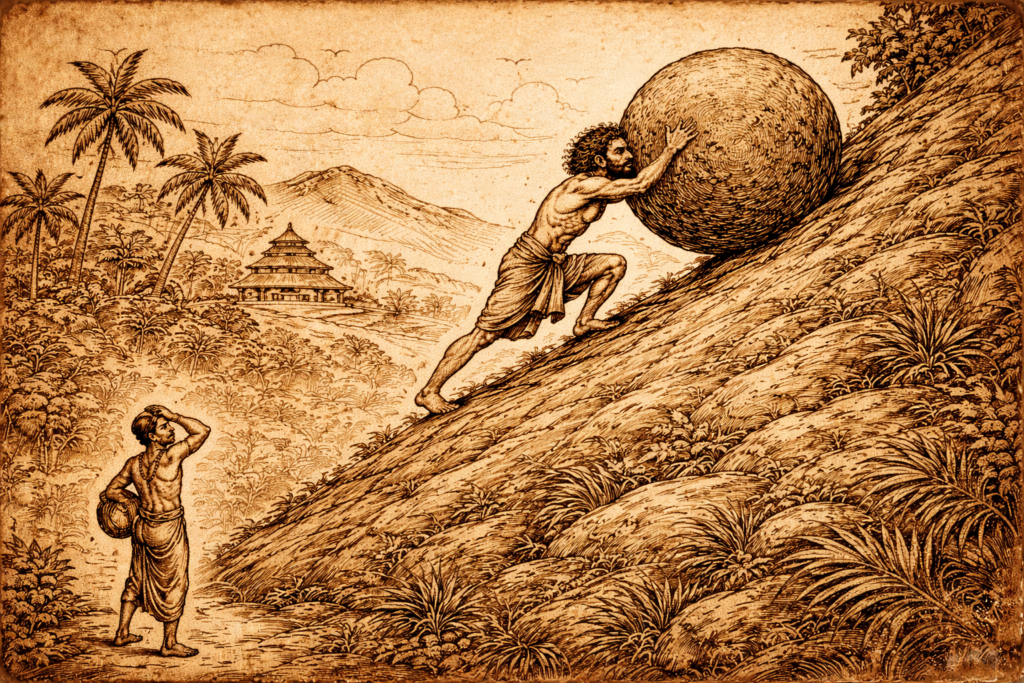
In the Palakkad district of Kerala, where the Western Ghats cast long shadows over paddy fields and temple ponds, there lived a man the villagers called mad.
His name was Naranathu Bhranthan — “the madman of Naranam.” But madness, in his case, was a matter of perspective.
Bhranthan was no ordinary wanderer. He was born of a remarkable lineage — one of the twelve children of Vararuchi, the legendary Sanskrit scholar who had served in the court of King Vikramaditya. His mother was Parayi, a woman of humble caste, and from this unlikely union came twelve children who would each leave an indelible mark on Kerala’s history and folklore. They were known collectively as the Parayi Petta Panthirukulam — the twelve children of Parayi.
Bhranthan grew up sharp-minded and deeply philosophical, but he saw the world differently from other men. Where others chased wealth, status, and comfort, he saw only illusion. Where others built, he watched things fall apart. And he found this — not tragic — but hilarious.
Every single morning, without fail, Bhranthan would walk to the foot of Rayiranellur Hill near Thiruvegappura. There, he would find a massive boulder. And he would push it.
With extraordinary effort, grunting and straining, he would roll that giant rock up the slope — inch by inch, hour by hour — all the way to the top. Villagers would stop and stare. Some mocked him. Some pitied him. Some simply shook their heads.
And then, when the boulder finally reached the summit, Bhranthan would let it go.
He would watch it thunder back down the hill, crashing and bouncing, raising dust, until it came to rest exactly where it had started.
And then he would laugh. A deep, full-bellied, genuine laugh — as if he had just witnessed the funniest thing in the world.
The villagers were baffled. “Why do you do this?” they asked. “You push the rock up, it comes down, and you laugh. What is the point?”
Bhranthan would look at them with eyes that were anything but mad.
“What is the point of anything you do?” he would reply. “You build houses — they crumble. You earn money — you leave it behind when you die. You raise children — they go their own way. You push your own boulders up your own hills every single day. At least I know mine will fall. Do you?”
The villagers had no answer.
Bhranthan was not rolling a boulder. He was holding a mirror to the human condition — showing anyone who cared to look that all of life’s frantic striving ultimately returns to where it started. That the effort itself is the point, not the destination. That the wise man laughs at the absurdity, rather than weeping.
Scholars have noted the striking similarity between Bhranthan’s story and the Greek myth of Sisyphus — condemned by the gods to roll a boulder up a hill for eternity. But where Sisyphus was punished, Bhranthan chose. That is the difference. One was a prisoner of fate. The other was a free man who simply understood it.
He lived on that hill for many years. The Devi — the Goddess — is said to have appeared to him there, moved by his devotion and his wisdom. The spot where she appeared was later consecrated into a temple, where water still flows from a sacred pit that never runs dry.
The madman of Naranam left no written philosophy, no disciples, no kingdom. He left only a story — and a laugh that still echoes across the hills of Palakkad.
Naranathu Bhranthan is one of the legendary figures from Aithihyamala, the great collection of Kerala folklore compiled by Kottarathil Sankunni in the early 20th century.