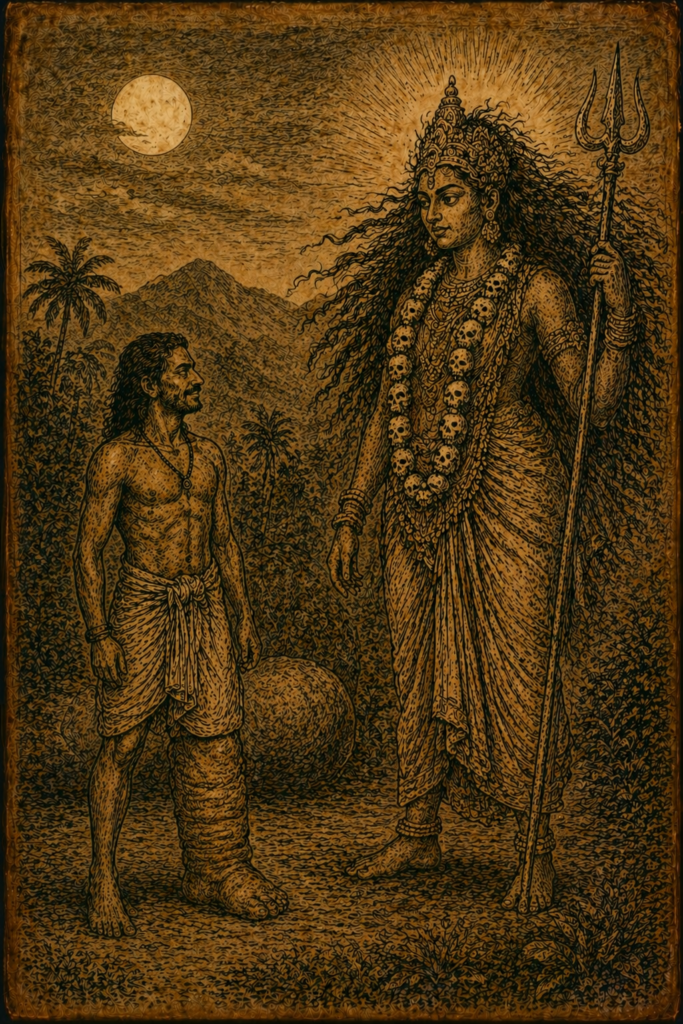
He had laughed at kings. He had laughed at death. But when she appeared, even Bhranthan went silent.
Part One: The Offer
There is a story about Naranathu Bhranthan that the tradition preserves with particular care — not the boulder story, which everyone knows, but a story about the night he met the Goddess and what happened when she offered him a boon.
It is a short story, in the way that the best stories are short. It contains more than it appears to contain. And it reveals something about Bhranthan that the boulder story, for all its depth, does not quite reach.
He was at Rayiranellur hill, as usual, on the first day of the month of Thulam. This is the night in the Kerala calendar when the Goddess is particularly present — when the veil between the visible and invisible worlds is at its thinnest, when the sacred is close enough to touch. On this night, the tradition holds, Bhadrakali appeared to Naranathu Bhranthan on the hill.
She appeared in the form that she chose for this encounter — which is to say, in the form appropriate to who Bhranthan was and what the encounter was for. Not the terrifying form that the tradition reserves for her appearances in battle or in judgment. Something closer to what he had always known she was: the same reality he had been rolling his boulder toward, year after year, in the only language available to him.
He did not fall to his knees this time. He looked at her.
She said: ask me for a boon.
This is the traditional formulation — a deity who has been pleased or moved by devotion or simply chooses to be generous makes the offer. It is an offer with conditions: the boon must be asked, and it must be within the power of the granting deity to give.
Bhranthan’s response was immediate.
“I need nothing,” he said. “There is nothing you can give me.”
This was not humility in the performed sense — the ritual humility of someone who says they need nothing while demonstrating their need for the deity’s approval. It was a statement of actual fact, as Bhranthan understood the situation. He had been pushing a boulder up a hill for years and watching it fall and laughing. He had arrived, through that practice, at a state in which the usual human needs — for security, for status, for the resolution of uncertainty, for the continuation of a particular self through time — had become, if not absent, then transparent. He could see through them to what they were made of. And what they were made of did not require a boon.
The Goddess, the tradition tells us, persisted. She told him she could not leave without granting a boon to any human being she encountered. It was the rule. He would have to ask for something.
Bhranthan looked at her. He thought for a moment — and the thinking of Naranathu Bhranthan was never the thinking of an ordinary man working through an ordinary problem. It was the thinking of someone who had spent years in the company of the fundamental question, and who brought that question to bear on every situation.
Then he smiled.
“Very well,” he said. “Add one second to my lifespan.”
Part Two: The Boon He Asked For
The Goddess paused.
Adding one second to a human lifespan is not, on the surface, a large request. Bhranthan was not asking for immortality or great wealth or military victory or the resolution of a long-standing theological dispute. He was asking for one second.
But the Goddess knew — as deities do, as anyone who has thought carefully about time knows — that the request was not small at all. One second of lifespan, added to the end of a life that has already been set in motion by karma and circumstance, by the chain of causes and effects that constitute an existence — this cannot simply be inserted. Time is not a line that can be extended by attaching a small piece at the end. It is woven through with everything else. One second more means one second more of everything: of breathing, of the heart beating, of the world continuing to exist as it does, of all the consequences that flow from all the causes that have been set in motion. One second, added, means everything that follows from one second, which is infinite.
She could not do it.
“I cannot grant that,” she said.
Bhranthan’s smile did not change. “Then take one second away,” he said.
The same problem, in reverse. One second less of lifespan means one second earlier that breathing stops, the heart stops, the chain of consequence terminates. But when exactly? Which second? The one that was going to contain a word spoken to someone, a thought that would have changed something, a breath that was holding something in place? You cannot remove a second from a human life without unraveling the fabric that the second was woven into.
She could not do that either.
“I cannot grant that,” she said.
Now Bhranthan laughed. Not the boulder laugh — this was a different quality of laugh, quieter, with more warmth in it. The laugh of a man who has asked two impossible questions and received, in the impossibility of the answers, exactly what he was looking for.
“Then grant me this,” he said. “The manth on my left leg — shift it to my right leg.”
Part Three: What He Was Asking
A manth is a supernatural affliction — a condition visited upon a person through ritual or curse or the working of invisible forces, manifesting in the physical body in ways that the medical tradition of the era would have recognized as illness and that the spiritual tradition recognized as something more specific. Bhranthan had a manth on his left leg. It was a known part of his condition — one of the things that the villagers who described him mentioned alongside the boulder and the laughing and the unusual attire.
The Goddess shifted the manth from his left leg to his right leg.
She could do this. It was within her power. The manth remained — he was not cured, not healed, not relieved of the condition. It simply moved from one leg to the other.
Bhranthan thanked her. And the Goddess departed.
Part Four: What This Story Is About
The tradition preserves this story because it says something about Bhranthan that the boulder story, for all its depth, cannot quite reach. The boulder story is about wisdom — about the understanding that comes from sustained engagement with futility, about the difference between knowing the boulder will fall and being destroyed by its falling. It is a magnificent story. But it is a story about understanding.
This story is about freedom.
Bhranthan asked the Goddess to add one second to his life. She could not. He asked her to take one second away. She could not. What he demonstrated, in the asking and in the impossibility of the granting, is that his life was not a quantity that could be adjusted. It was what it was — the specific, particular, irreducible thing that it was — and nothing could be added or subtracted from it from the outside. Not even the Goddess could change its measure.
This is freedom in the specific sense that the tradition understands it — not the freedom to do whatever you want, which is not freedom but appetite. The freedom that comes from being exactly what you are, exactly where you are, with nothing missing and nothing extra. The freedom of the man who, when asked what he needs, genuinely has nothing to ask for — not because he has given up wanting but because wanting and not-wanting have both become transparent to him.
The shift of the manth from the left leg to the right leg is the final flourish — the signature of the Bhranthan we know from all the other stories. He could not leave the encounter without asking for something, because the Goddess had insisted. So he asked for something that cost him nothing, changed nothing that mattered, and was entirely consistent with the position he had been demonstrating since the first morning he pushed the boulder: that the conditions of his existence were exactly as they were, and he had no fundamental objection to any of them.
He just moved the manth.
He was probably laughing as he walked home.
Part Five: The Legacy on the Hill
Bhranthan died on Rayiranellur hill. Or rather — the tradition uses language that does not quite say died, because the tradition, when it is being careful, reserves that word for people for whom death is a conclusion. For Bhranthan, it was more like an arrival. He had been walking toward something for his entire life, rolling his boulder and laughing and asking whether it was noon yet, and at some point on Rayiranellur hill he arrived.
Where the Goddess had placed her foot — where she had stood on the night of Thulam — a temple was built. Not by anyone’s decision exactly, but in the way that temples come to exist in Kerala: through the accumulated weight of recognition, the communal acknowledgment that something happened here, that the place carries what happened in the way that certain places carry certain things.
The temple has a pit. The pit is the mark of the Goddess’s footprint, the tradition says. And the pit has always, in every season and in every drought, been full of water. The priests take water from it for the rituals. It does not run dry.
Every year, on the first day of Thulam, thousands of people climb Rayiranellur hill. The climb takes an hour and a half, through laterite scrub and the particular heat of the Palakkad plain. At the top, there is the temple, and there is the statue of Bhranthan — lean and weathered, the boulder beside him, the expression on his face the one you would expect: somewhere between a question and a laugh.
The people who climb the hill come for blessings. For marriage, for children, for health, for the resolution of difficulties. They come with the human needs that Bhranthan had transcended, and they climb the hill that he climbed, and they ask for what they need.
He would not have found this contradictory. He would probably have found it funny, in the warmest possible way — that the hill where he had demonstrated the futility of asking for anything had become a place where people came to ask for everything. That the man who had told the Goddess he needed nothing had become, after his death, the intermediary through whom thousands of people expressed their needs.
Is it noon yet? he had called out across the valley, year after year.
For most of the people who climb his hill, the answer is still no. The light has not reached its peak. They are still working in the shadow, still rolling their boulders, still hoping the next arrangement will be the one that holds.
He would understand. He had been there too.
He would wish them, in whatever form wishes take from where he is now, good pushing.
And he would laugh.
Naranathu Bhranthan is one of the legendary figures from Aithihyamala, the great collection of Kerala folklore compiled by Kottarathil Sankunni in the early twentieth century. The Rayiranellur temple in Palakkad district is one of the most visited pilgrimage sites in the region. His story has inspired one of the most celebrated poems in the Malayalam language, written by V. Madhusoodanan Nair, which went through forty editions — a record in Malayalam publishing.