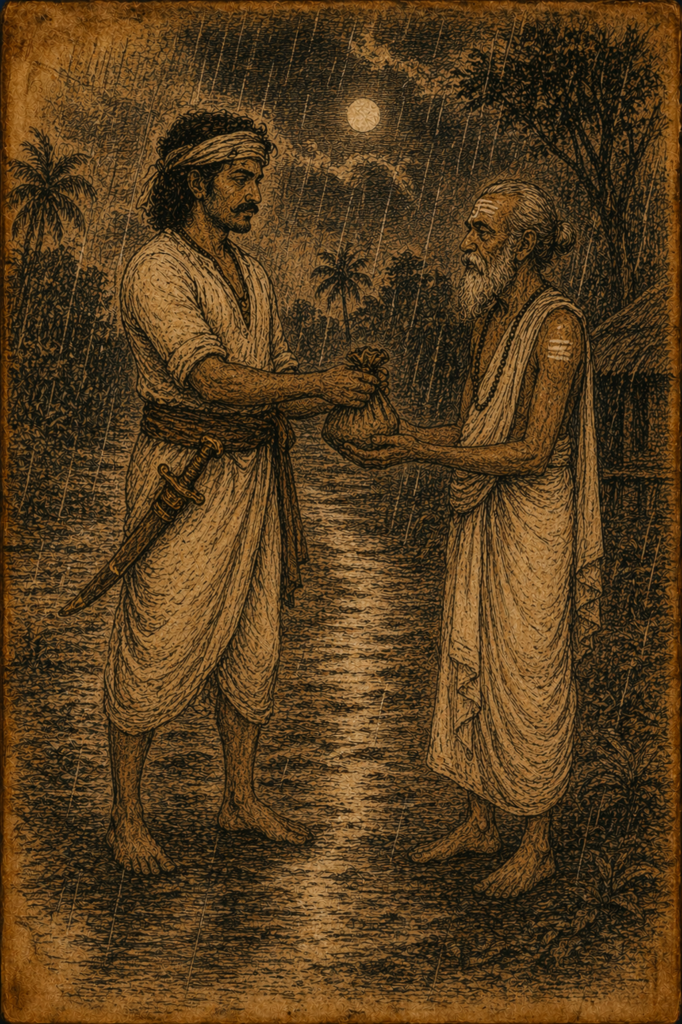
He never robbed a poor man. Not once. Not in thirty years on the roads of Travancore.
The roads of Travancore in the mid-nineteenth century were not roads in any modern sense. They were tracks — some of them ancient, worn into the laterite soil by centuries of foot traffic, following the logic of the landscape rather than any planner’s intention: along the edges of paddy fields, through gaps in the coconut groves, across the wooden bridges that spanned the backwater channels, around the hillocks that the excavation technology of the era could not flatten.
On these roads moved everything that the kingdom of Travancore depended upon: rice, coconut, coir, pepper, cardamom, the taxes collected from the farmers, the tribute due to the landlords, the salaries of the British Residency officials, the goods of the merchants. Moving wealth along these roads required either power — the power of the state, which provided armed escorts for those who could afford them — or invisibility — the ability to look poor enough that nobody thought you worth robbing.
Kayamkulam Kochunni had neither power nor invisibility. What he had was Kalaripayattu, an intimate knowledge of every path and backwater channel between Kayamkulam and Ernakulam, a mind that processed information about his environment faster than most people could process information about a conversation, and a philosophy about the distribution of wealth that the landlords and the colonial administrators would have described as criminal and that the poor farmers of the region described, in hushed and admiring tones, as justice.
He was born in 1818 in Kayamkulam, in what is now Alappuzha district, into a Muslim family of modest means. His full name was Kochunni Mappila. He learned Kalaripayattu in the way that talented poor boys of his region and era learned it — through a combination of formal instruction and necessity, the latter being a more effective teacher than the former.
By the time he was in his twenties, he had already developed a reputation that made merchants nervous and gave poor farmers a feeling, complex and not entirely explicable, that there was something in the world that was on their side.
The mechanics of Kochunni’s operations were elegant in their simplicity. He did not maintain a gang in the conventional sense — he worked with small groups of trusted associates, and the composition of these groups shifted depending on the target and the terrain. He was not violent by preference; the Kalaripayattu training was for deterrence as much as for application, and he understood that a reputation for invincibility was more useful than the continuous demonstration of it.
What he did, essentially, was taxes. He taxed the taxers.
The landlords who charged their tenant farmers crushing rents. The merchants who kept two sets of prices — one for the records and one for the actual transaction. The tax collectors of the Travancore administration who helped themselves to a percentage of what they collected before remitting the rest. The British Residency officials who understood that their distance from Madras and London created opportunities that a sensible man would exploit.
From all of these, Kochunni collected. Not everything — he was not greedy, which was one of the things that distinguished him from the people he robbed. He took what he calculated was the excess: the surplus of exploitation, the margin between what was fair and what was being charged.
This calculation was not always precise. But it was always made. And the result of it, distributed through the poor households of the region with a discretion that amounted to a kind of financial ghost network, had effects that were real and material and remembered long after Kochunni himself was gone.
The widow in Haripad who kept her home because someone left money at her door the night before the landlord’s men were due. The fisherman in Muhamma whose boat was replaced, inexplicably, after the old one was destroyed in a storm. The family in Purakkad who found, in the weeks after their son was imprisoned on a fabricated charge, that the cost of his release had been paid by sources they could not trace.
These things happened. The people they happened to knew roughly where they came from. They did not speak of it openly, because speaking of it openly would have been dangerous.
But they remembered.
The colonial administration hated Kochunni with a thoroughness that tells you something about how effective he was. He appears in the official records of the British Residency in Travancore with a frequency that is remarkable for a man who was, technically, a minor regional criminal. The dispatches to Madras describe him variously as “a notorious dacoit,” “a persistent menace to commerce,” and, in one dispatch from a Residency official who appears to have been having a bad week, “apparently possessed of supernatural abilities of concealment and escape.”
The supernatural abilities were, in fact, natural abilities: Kochunni knew the backwater network of central Kerala the way a scholar knows a text he has studied for twenty years. He knew which channels connected to which, which were navigable at which seasons, where the water hyacinth grew thick enough to hide a boat, where the egrets roosted in numbers large enough to provide warning of approaching strangers. He had allies in every fishing village between Kayamkulam and Kochi — people who owed him nothing contractually but who owed him something larger and less articulable, and who expressed that debt in information, in shelter, in silence.
The British sent troops after him. The troops found, consistently, that they had arrived somewhere Kochunni had been rather than somewhere he was. He seemed to exist in the immediate past rather than the present — always just ahead of pursuit, always just around the corner, always leaving traces but never leaving himself.
There are stories — not all of them verifiable, but not all of them invented — of his encounters with the officials who hunted him. A sub-collector who came close to capturing him, and who found, the next morning, that the strongbox in his office had been opened and the tax collection from the previous month removed, with a note that said simply: For the people it came from. A British officer who stopped at a roadside toddy shop for water and found himself in conversation with a laborer who asked him many questions about the hunt for Kochunni and offered several helpful suggestions about where he might be found — suggestions that proved, on investigation, to be entirely wrong in the most expensive possible way. The laborer was, of course, Kochunni.
He was captured in 1859. Not through any great feat of detection or force, but through betrayal — the oldest method, the one that no amount of Kalaripayattu training and no network of allies can fully protect against, because betrayal comes from within.
He was tried, convicted, and imprisoned. He died in custody that same year, 1859.
The official record closes there. The record of the people he lived among does not.
In the villages of Alappuzha and Kottayam and the backwater districts of central Kerala, Kochunni passed, in the decades after his death, from history into folklore. This transition is worth examining, because it does not happen automatically. Not every criminal becomes a folk hero. The transition requires that people recognize in the figure something that goes beyond the specific acts — something about what the figure represented, what side they were on, what they were against.
What Kochunni represented, as understood by the people who made him legendary, was this: that the system of extraction — the layered, self-reinforcing system by which the labor and resources of poor people were converted into the wealth of powerful people — was not inevitable, was not natural, was not beyond challenge. That a man with sufficient skill, sufficient intelligence, and sufficient clarity about whose side he was on could, within the limits available to him, push back.
He did not overthrow the system. One man cannot overthrow a system. But he made it less comfortable to operate. He introduced friction into the machinery of exploitation. He made the tax collectors nervous and gave the farmers something to feel that was not pure helplessness.
This, the people of central Kerala understood, was not nothing.
His name in the folk ballads and stories of central and southern Kerala sits alongside warriors and priests and philosophers. He is not there because he was the most powerful or the most learned or the most spiritually advanced. He is there because he was on the right side. In a world full of people who had chosen power or chosen silence, Kayamkulam Kochunni had chosen something else.
And Kerala remembered.
Kayamkulam Kochunni is one of the legendary figures from Aithihyamala, the great collection of Kerala folklore compiled by Kottarathil Sankunni in the early 20th century. He lived from approximately 1818 to 1859.