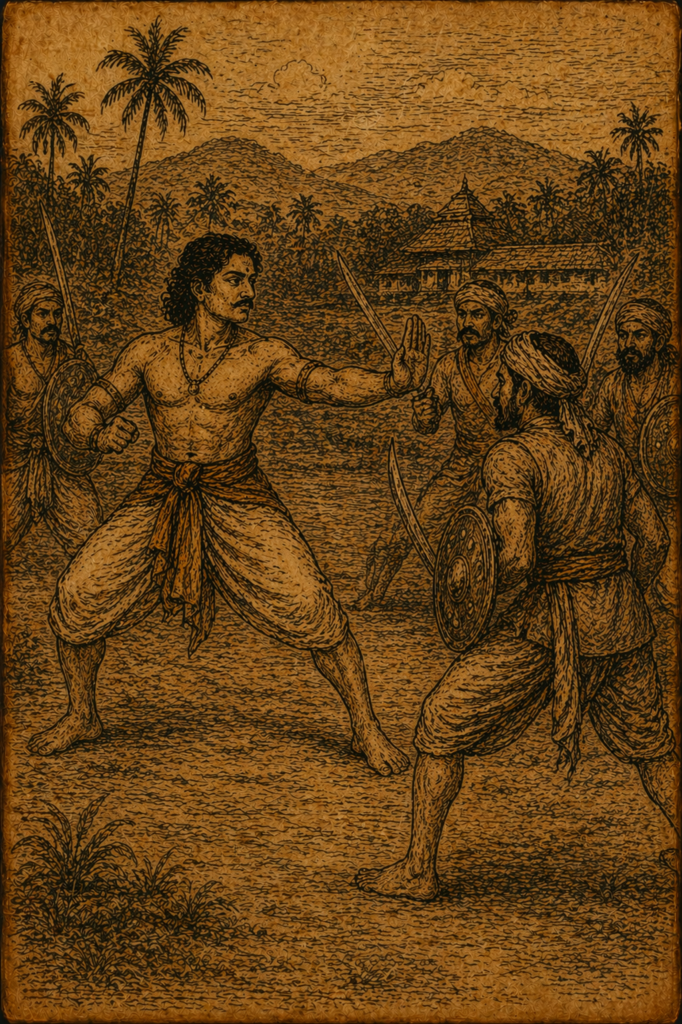
They said he was born with a sword in his hand. The midwife who delivered him would not confirm or deny this.
The first thing you need to understand about the Thacholi family is that the name meant something.
In the martial world of sixteenth century North Malabar — a world of feudal rivalries and ankam duels, of Kalaripayattu masters and warrior clans whose reputations were measured in the quality of their enemies — the name Thacholi was not merely a family name. It was a category. It meant a specific lineage of fighters, a specific standard of training, a specific code of conduct that had been maintained across generations until it had become inseparable from the name itself.
Into this family, in the village of Thacholi near Vadakara, was born a boy whose real name was Udayana Kurup. The ballads would call him Othenan. The people of North Malabar, in the way that people compress greatness into familiarity, would call him simply Thenan.
He won his first fight at the age of eight.
——
The Kalari pit in the early morning is not a comfortable place. Before dawn, when the oil lamps are still burning and the air smells of coconut oil and the earth floor is cold under bare feet, the gurukkal calls his students and the day’s work begins. Stretches that would break an untrained body. Sequences repeated until they stop being sequences and become something that lives in the muscle rather than the mind. The body learning, slowly and painfully, to do things that the thinking mind would consider impossible.
Othenan trained under Mathiloor Gurukkal — a master of the tradition, demanding in the way that masters who take the art seriously are always demanding. He trained with his companion Kandachery Chappan, who would remain beside him through the years of fighting that followed. He trained with the full range of weapons that the Kalaripayattu tradition required — the body first, then the long staff, then the short stick, then the sword and shield, then the flexible whip-sword called the urumi, a weapon of such difficulty and danger that most fighters avoided it entirely.
Othenan loved the urumi. Its long flexible blade, capable of wrapping around a shield and finding the body behind it, suited something in his temperament — the preference for the unexpected angle, the solution that the opponent had not prepared for. When he walked the roads of North Malabar in later years, it was the urumi at his side that people noticed first.
He was devoted to the Bhagavathy of Lokanarkavu — the temple just outside Vadakara town, the family temple of the Thacholi house, where the deity presided over a tradition that mixed the sacred and the martial in the way particular to Kerala’s warrior culture. Before combat, he prayed. After combat, he returned. The goddess and the fighter understood each other.
——
The ballads describe his fighting with consistent precision on one point: he was chivalrous. Not in the soft sense the word has acquired, but in its original meaning — governed by a code, operating within rules that he had set for himself and that he maintained regardless of the circumstances.
He did not fight the unarmed. He did not fight the weak. He did not fight those who had not come to fight. These were not policies he announced. They were simply what he did, and what he did not do, and the people of North Malabar read the code in his behavior over years and understood what it said about the man.
The legends portray him as merciless to enemies and a friend to the helpless. This is not a contradiction, in the tradition that produced him. Mercy, in that world, was context-specific. Against a genuine opponent in an ankam — a formal duel, with its own strict protocols of honor — you gave everything. You held nothing back. The opponent who had agreed to face you deserved the full weight of your capability, not a performance. But the man who had not come to fight, who was not your enemy, who happened to be in the road when you were passing — he deserved something else entirely.
Othenan knew the difference. He always knew the difference.
Even the Zamorin of Calicut — the most powerful ruler on the Malabar coast, a man accustomed to deference — is said to have respected Othenan. Not because Othenan sought his approval. But because the Zamorin, who understood capability, recognized it when he saw it.
——His greatest opponent was Kathirur Gurukkal — also known as Mathiloor Gurukkal, the same master who had given Othenan his first training. A man whose name commanded silence in the places where fighters talked about fighters. The quarrel between them began at a festival day at Lokanarkavu temple, with a few words that landed wrong, and it ended the only way such quarrels between proud men of that world could end: with a challenge to an ankam.
The duel was fought over three days at Ponniam Ezharakandam in Kadirur — a paddy field area already known throughout the region as a place where warrior blood had been spilled. Othenan's family tried to stop him. His elder brother Koma Kurupp argued, pleaded, warned. A man who challenges his own former Guru is not just fighting a man, he said. He is fighting everything the Guru has built across a lifetime.
Othenan fought anyway. And on the third day, using a technique called Poozhikkadakan — learned not from the Gurukkal but from his colleague Payyamvelli Chanthu, a technique the Gurukkal had never taught him and may not have known he carried — he killed Mathiloor Gurukkal at Ponniam Ezharakandam.
He was thirty-two years old.
He picked up his weapons and began the walk back to Vadakara with his companions. The victory procession moved through the late afternoon light, through the paddy fields and coconut groves of Kadirur, the men around him already beginning to feel the loosening that comes after three days of sustained danger.
Somewhere on the road, Othenan stopped.
He had left his kattaram at the field. The short dagger, his hand weapon, was still lying near the ankathattu — the fighting ground at Ponniam.
His brother told him to leave it. There was a rule: no warrior returned to the arena after the fight was over. To go back was taboo. Koma Kurupp said this. His companions said this.
Othenan said: a warrior who leaves his weapon behind will be described as a man who fled. That story will follow the Thacholi name long after I am gone.
He turned around and walked back alone toward Ponniam.
Parunthunkal Emman Panicker had been watching the procession leave. He had seen the kattaram lying near the ankathattu. And he had understood, with the cold precision of a man planning something that honor would not permit him to do openly, that Othenan would come back for it.
He made his arrangements before Othenan arrived.
Mayin Kutty was hidden in the field when Othenan walked back in. Not where Othenan could see him. The ballads record that he hid himself — in the manner of a man who has calculated correctly that his only advantage is in not being visible, because facing Othenan directly was not something he was willing to attempt.
Othenan was killed at Ponniam Ezharakandam. Not in combat. Not in an ankam. Returning alone to retrieve a weapon he had left behind, because leaving it would have dishonored his family's name.
The ballads remember Parunthunkal Emman Panicker's name. They remember Mayin Kutty's name. Not to honor them — but because the tradition understood that the names of the men who could only kill Othenan through treachery were themselves a testament to what he was.
The full story of the three days at Ponniam — the quarrel, the duel, the technique that decided it, and the walk back that ended everything — is told in Thacholi Othenan: The Duel at Loknarkavu.
Thacholi Othenan is one of the legendary figures of Vadakkan Pattukal and appears in Aithihyamala, compiled by Kottarathil Sankunni in the early 20th century.