The quarrel started over a few words at a temple festival. Most things in North Malabar did.
It was a festival day at Lokanarkavu — the ancient Bhagavathy temple outside Vadakara, Othenan’s family temple, the place he prayed before every fight and returned to after. The temple grounds on festival days were crowded with people from the surrounding villages, and crowded festival grounds in sixteenth century Malabar had a particular quality: they were places where pride was on display, where reputations were present in person, where the wrong word in the wrong company could set off consequences that neither side had planned for.
Mathiloor Gurukkal was there. He was also known as Kadirur Gurukkal, the master who had given Othenan his first training. He had, by this point in his life, taught tens of thousands of students across the region. He was one of the most respected Gurus in North Malabar, a man whose name meant something in the circles where such names were tracked.
Othenan said something. The ballads are not specific about what — the tradition preserves the fact of the quarrel more carefully than its content, because the content was the kind of thing that happened between proud men at crowded festivals and the content was not the point. The point was what Mathiloor Gurukkal heard in it.
He heard disrespect.
He challenged Othenan to an ankam.
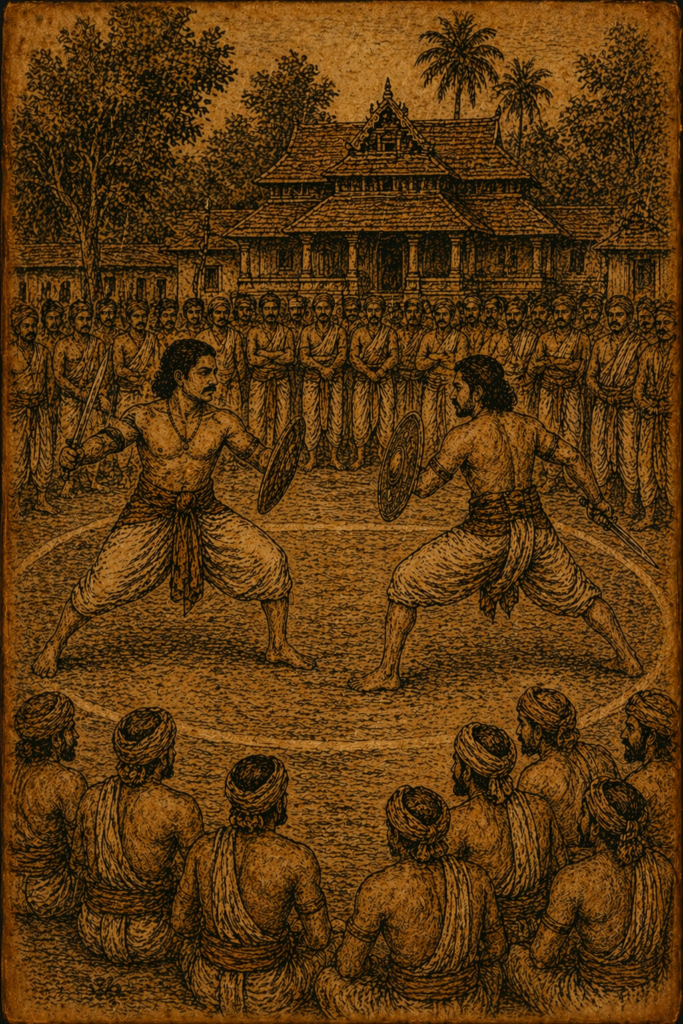
An ankam was not a brawl. It was a formal duel with a strict structure, arranged in advance, conducted under specific conditions, witnessed by people whose standing was sufficient to make their account credible. Challenging someone to an ankam was a serious action. It meant: this cannot be settled any other way. It meant: one of us will not leave the field alive.
Othenan accepted.
The date was fixed for the ninth, tenth, and eleventh of Kumbham. The venue was Ponniam Ezharakandam — a paddy field area in Kadirur panchayat in what is now Kannur district, a place well known in the region as a site for ankam duels. There was already a verse in the ballads about it, reminding those who entered it that the soil had drunk a great deal of warrior blood.
When Othenan’s family heard the news, his elder brother Koma Kurupp tried to stop him.
This is worth understanding. Koma Kurupp was not a coward, and he was not trying to protect Othenan from an unworthy opponent. He was trying to protect him from a man he had reason to fear. Mathiloor Gurukkal had trained tens of thousands of students. He had been a master of the art longer than most of his students had been alive. In the calculations of the martial world of North Malabar, challenging your own former Guru to an ankam was not simply bold. It was the kind of thing that went wrong.
Othenan’s family understood what was at stake. In an ankam, the defeated fighter was killed. This was not a penalty or an escalation. It was the expected conclusion. An ankam was a question with two possible answers, and one of them was death.
Othenan went anyway.
He arrived at Ponniam Ezharakandam on the ninth of Kumbham. The field was ready. The witnesses were in place. Mathiloor Gurukkal was already there.
What happened over the next three days is what the ballads were made to preserve.
A three day ankam was not three separate fights. It was one encounter, drawn out over days because the fighters were too evenly matched to be separated quickly, each day adding to the accumulated weight of the previous, each night giving both men time to rest and to think about what the other man had shown them during the day. It was the tradition’s way of allowing for the possibility that neither fighter was simply better, that what would eventually decide the encounter was something beyond raw capability.
Something that revealed itself slowly.
Mathiloor Gurukkal was everything that his reputation said he was. He had spent a lifetime mastering the art, and in the field at Ponniam he moved with the completeness of a man who had nothing left to learn about the way he fought. He was precise. He was patient. He was, in the specific qualities that the northern tradition prized, very nearly perfect.
But Othenan had something the Gurukkal had not accounted for.
He had learned a technique called Poozhikkadakan — a method taught to him not by his Guru but by his colleague Payyamvelli Chanthu. A technique that the Gurukkal had not trained him in, that the Gurukkal may not have known he possessed. In the world of Kalaripayattu, a fighter’s techniques are known quantities to those who trained him. A Guru knows what a student has been taught, because the Guru taught it. But Poozhikkadakan had come from somewhere else.
On the third day, Othenan used it.
He beheaded Mathiloor Gurukkal at Ponniam Ezharakandam.
Then he picked up his weapons and began the walk back to Vadakara with his companions, the victory procession moving through the late afternoon light of Kumbham, through the paddy fields and the coconut groves of the land he had fought in and would go home from.
Somewhere on the road, he stopped.
He had left his kattaram at the field. The kattaram — a short dagger, a hand weapon — was still lying near the ankathattu, the fighting ground at Ponniam.
His brother told him to leave it.
There was a rule in the ankam tradition. No warrior returned to the arena after the fight was over. To go back was taboo, a violation of the code that the entire structure of the ankam rested on. Koma Kurupp said this. His companions said this.
Othenan said: a warrior who leaves his weapon behind will be described as a man who fled. He will be remembered as someone who dropped his weapon and ran. That story will follow the Thacholi name long after I am gone.
He turned around and walked back toward Ponniam.
Parunthunkal Emman Panicker had been watching. He was Mathiloor Gurukkal’s man, and he had understood, as the procession was leaving, that Othenan had left his kattaram behind. He had seen the weapon lying near the ankathattu. And he had understood something that he chose not to share with anyone who would stop him: Othenan would come back for it.
He made his arrangements.
Mayin Kutty was waiting somewhere in the field when Othenan returned. Not where Othenan could see him. Not where a man walking into a field to retrieve a weapon would think to look. The ballads say he hid himself, in the manner of a man who understands that his only advantage is in not being visible.
Othenan was thirty-two years old. He had won sixty-four ankam duels in the course of his life. He had fought opponents who came at him directly, with weapons, in the formal structures of the tradition that he had mastered across two decades of genuine combat.
He had never been prepared for what could not be seen.
The field at Ponniam took him. Not in combat. Not in an ankam. In the way that the ballads record with a kind of furious precision, as if the specificity of the detail is itself an argument: he was killed from hiding, by a man who had calculated correctly that there was no honest way to do it.
His kattaram was still on the ground when they found him.
The ballads remember Parunthunkal Emman Panicker’s name. They remember Mayin Kutty’s name. They remember these names not to honor them but because the tradition understood that the names of the men who could only kill Othenan through treachery were themselves a testament to him.
A warrior who died in an ambush because he went back to retrieve a weapon he had left behind, because leaving it would have dishonored the family name, because his sense of what the Thacholi name meant was stronger than his instinct for survival.
This is what the ballads chose to preserve. Not just the sixty-four victories. Not just the three days at Ponniam Ezharakandam. But the walk back across the field, alone, toward a weapon that mattered more to him than leaving did.
The Lokanarkavu temple still stands outside Vadakara. The paddy fields of Ponniam are still there in Kadirur panchayat. The hero stones that mark where the Thacholi house once stood are still in the grove at Thacholi, worn smooth by the rain of four centuries.
And the women of North Malabar are still singing.
Vararuchi is one of the legendary figures from Aithihyamala, the great collection of Kerala folklore compiled by Kottarathil Sankunni in the early 20th century.
.