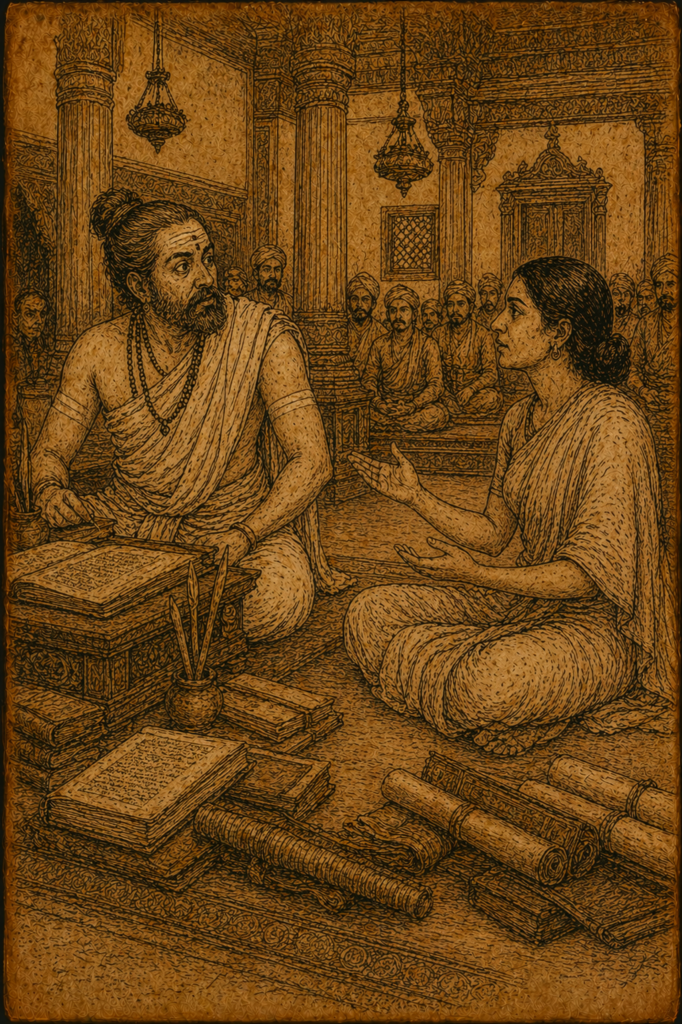
The question came on a Tuesday morning, in the middle of court, the way the most dangerous questions always do — casually, without warning, dressed as curiosity.
King Vikramaditya leaned forward on his throne and looked at Vararuchi. “Tell me,” he said, “which is the greatest verse in all of the Ramayana? And within that verse — which is the greatest phrase?”
The court went quiet. Twenty-four thousand verses in the Ramayana. Vararuchi had read all of them. He had memorized most of them. He had debated their meaning with the finest scholars of three kingdoms, and he had never, in any debate, been found wanting.
He opened his mouth. And found nothing there.
Not ignorance — that would have been simple. This was worse. He had too many answers. Every verse in the Ramayana was great. Every phrase could be argued as the greatest if you were skilled enough, and Vararuchi was skilled enough to argue for any of them. The question had no floor. He was standing on air.
“Give me forty days,” he said.
The king gave him forty days. He also gave him a condition: if Vararuchi returned without an answer that satisfied the court, he would be required to leave Ujjain and never return. His rivals, who had been waiting years for a moment like this, smiled at their laps.
——
He left the next morning. He traveled to every scholar he knew — in Ujjain, in Kashi, in the ashrams at the edge of the forests — and he asked each of them the same question. He got forty different answers. Some said the opening verses. Some said the verses of exile. Some said all of them equally and refused to choose, which was not an answer at all, and he knew it.
The days ran out like water. On the fortieth night, exhausted and empty-handed, Vararuchi was walking back toward Ujjain through a forest he did not recognize. He sat down at the base of a great ashvattha tree to rest. The sacred fig — whose roots, the Gita says, grow upward and whose branches reach down into the world. He leaned against the bark.
Above him, something moved.
He went still. In the branches, two Gandharvas had settled — celestial beings, creatures of the upper air whose conversations are not meant for human ears. Vararuchi, who had spent his life studying languages, had also studied theirs. He listened.
The first Gandharva spoke: “Do you know that man sitting under the tree?”
The second replied: “Vararuchi. The great scholar of Vikramaditya’s court. He has been wandering for forty days, looking for the greatest verse in the Ramayana.”
“Does he not know it?”
“He does not.”
A pause. Then: “It is the verse from the Ayodhya Kanda, the fortieth chapter, the ninth shloka. When Lakshmana comes to take his mother Sumitra’s blessing before entering the forest with Rama and Sita — Sumitra takes his face in her hands and says:
Ramam Dasaratham viddhi, maam viddhi Janakaatmajaam.
Ayodhyam ataveem viddhi, gaccha thaatha yattha sukham.
Know Rama as your father Dasaratha. Know Sita as your mother. Know the forest as Ayodhya. And then, my child — go happily.”
Vararuchi pressed his back against the bark and did not breathe.
The second Gandharva was quiet for a moment. Then: “There was a birth tonight. In the village below. A girl, born into a Parayi household.”
“I know,” said the first.
“Do you know whose fate is written on her head?”
A pause.
“His,” said the first Gandharva. “The man under the tree.”
——
Vararuchi sat very still for a long time after they left.
The Parayi were at the absolute bottom of caste world — untouchables, people whose shadow was considered polluting, whose existence the Brahmin world acknowledged only to exclude. And the Gandharvas had said, with the calm certainty of beings who read fate the way scholars read text, that a girl born into that world would become his wife.
He had two things now. He had the answer to the king’s question. And he had a problem.
He was a man who solved problems.
——
He went to the village before dawn. He found the household — a lamp burning at the infant’s head, in the custom of the time, and the child sleeping the absolute sleep of the newborn. He looked at the girl for a long moment.
Then he arranged for her to be placed on a plantain leaf and set afloat on the river. Gently. Carefully. He was not a cruel man. He simply could not allow the thing the Gandharvas had said to happen. He was thorough, as he was thorough in everything.
He returned to Ujjain on the forty-first day and stood before the court.
“The greatest verse in the Ramayana,” he said, “is from the Ayodhya Kanda, the fortieth chapter.” He recited it. He explained it — the three identifications Sumitra asks of her son, the way she transforms exile into homecoming with a single verse, the way love does what theology cannot. The court was silent. Then it erupted. The king stood.
His rivals swallowed their smiles.
Vararuchi resumed his place among the Navaratnas, and put the night in the forest behind him. The problem was solved. The girl was gone.
——
Fate, does not lose track of things.
A Brahmin in a distant town, childless despite years of prayer and ceremony, was walking along the river one morning when he saw something in the water. A plantain leaf. Moving steadily toward him, as if directed. On it, a small girl — alive, eyes open, a lamp somehow still burning at her head.
He lifted her out of the water and held her to his chest and wept.
He raised her as his own. She was sharp in the way that certain children are sharp — not just quick, but precise, the kind of mind that sees through the surface of things to the logic underneath. The Brahmin loved her the way a man loves something he knows he did not deserve but was given anyway.
When she came of age, a scholar passed through the town. A Brahmin of considerable reputation, known throughout the courts of the north. The father, wanting to honor him, invited him to dine.
The scholar accepted — but he accepted in code, the way learned Brahmins sometimes did, as a test of the household. “I will come,” he said, “if you prepare eighteen curries, and serve me what remains after feeding a hundred Brahmins.”
The father went pale. Eighteen curries was a feast that would take days. Feeding a hundred Brahmins first was impossible.
His daughter touched his arm.
“Go and rest,” she said. “I’ll prepare the meal.”
She placed a single long plantain leaf before the scholar. On it, rice that had been used as an offering at the Vaisvadevam ceremony — which, in the ritual mathematics of the tradition, was equivalent to rice fed first to a hundred Brahmins. Beside it, a single preparation of ginger — one ingredient, but prepared in such a way that it yielded many distinct flavors, each corresponding to one of the eighteen curries.
The scholar looked at the leaf. He looked at the girl standing before him, waiting without expression, knowing exactly what she had done.
He had traveled to every court in the subcontinent. He had debated every scholar worth debating. He had never, in forty years of studying the texts of the tradition, met anyone who read his code as fast as she just had.
He asked to marry her.
The father wept again — this time with joy.
Her name was Panchami.
——
They were married. The early days were what the early days of good marriages are — full of the small discoveries that a life together consists of. One afternoon, some weeks after the wedding, they were sitting in the courtyard in the heat of the day. Panchami was lying with her head in Vararuchi’s lap. He was speaking, she was listening, and he was running his hand absently through her hair.
His fingers stopped.
At the centre of her scalp, half-hidden in the roots of her hair, was a small dark scar. Old and well-healed, but unmistakable once you had found it.
“What is this?” he asked.
She told him without hesitation, the way you tell a husband something ordinary. She was not the Brahmin’s biological daughter. He had found her floating on the river on a plantain leaf, an infant with a lamp at her head, and had raised her as his own. She had always known this. It was not a secret. It was simply her history.
Vararuchi did not speak.
The courtyard. The afternoon heat. A crow somewhere on the roof. His wife’s voice, fading, as she noticed that he had gone somewhere she could not follow.
He sat for a long time. Long enough for the shadow of the wall to move across the ground.
The plantain leaf. The lamp. The river. The infant he had lifted from the Parayi household in the dark and set afloat because the Gandharvas had told him his fate and he had decided to correct it.
He had corrected nothing. He had carried her down the river himself. He had placed her, with his own careful hands, directly into the path that led here — to this courtyard, this afternoon, this woman whose head was still in his lap.
He was the greatest scholar in the court of Vikramaditya. He had an answer for everything.
He had no answer for this.
——
He told her. All of it — the ashvattha tree, the Gandharvas, the night, the household, the river. He told her what he had done and why, and what it had produced. He told her what she was and what that meant, in the world they had both been living in.
She listened without moving. Then she was quiet for a moment, the way a person is quiet when they are deciding not what to think — she already knew what to think — but how to carry it.
“Then neither of us could have avoided this,” she said.
He had no argument. She was right. She was, he understood now, almost always right — not through scholarship but through the particular clarity of someone who has never been able to afford illusions.
He could not stay. A Brahmin who had married a Parayi — even in ignorance, even without knowing — had no place left in the world he had lived in. He announced his own ex-communication. He did not wait to be asked.
They left together. Walking south, toward the Sahyadri mountains and beyond them the long green land that the tradition called Kerala. The red laterite roads. The river Nila. The coconut groves and the paddy fields and the villages where people stopped and looked at the Brahmin scholar and his Parayi wife and could not find a category for what they were seeing.
They looked. Vararuchi and Panchami walked.
——
What happened next — the twelve children born on roadsides across Kerala, the question Vararuchi asked at every birth, and the twelfth child who became a god on a hill — belongs to both of them, and it is a longer story than this one.
That story is told in Parayi Petta Panthirukulam: The Twelve Children of Panchami.
Vararuchi is one of the legendary figures from Aithihyamala, the great collection of Kerala folklore compiled by Kottarathil Sankunni in the early 20th century. The story of Vararuchi and Parayi, and their twelve children — the Parayi Petta Panthirukulam — remains one of the great story cycles of Kerala’s cultural heritage.