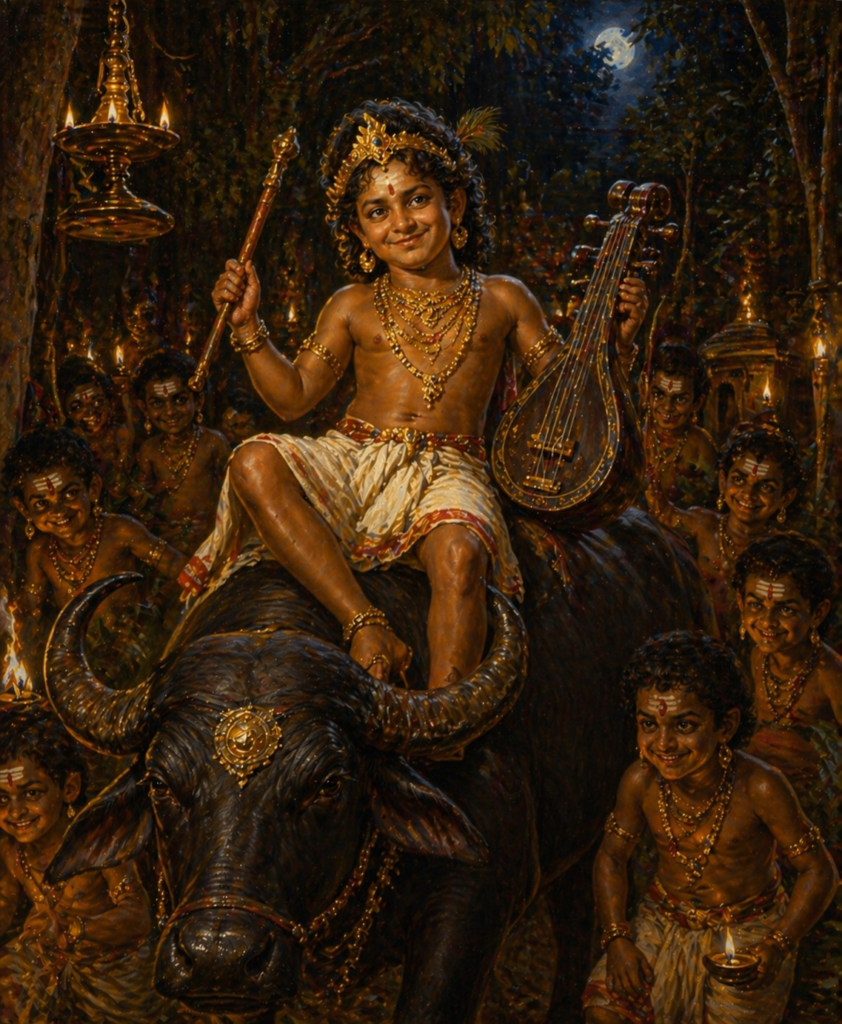
The Son of Shiva Who Was Raised by a Tribal Woman
Before the temples were built, before the priests arrived with their Sanskrit and their rituals, the forests of Kerala had their own gods. They were not distant gods who required elaborate ceremony. They were gods you could hear — in the crack of a branch at night, in the sound of a flute drifting through the trees when there was no one there to play it, in the heavy footfall of something too large to be a man moving through the undergrowth just beyond the edge of the firelight.
One of them rode a buffalo. He was nine years old. He carried a short stick called a kuruvadi. He played a seven-stringed instrument called the ezhara that made a sound like nothing else in the forest.
His name was Chathan. The people who loved him called him Kuttichathan — the little one. The tradition that grew around him would eventually call him Vishnumaya — the one who creates illusions in the form of Vishnu. But in the beginning, in the Kooli forest, he was just the boy who appeared one morning in the arms of a tribal woman named Koolivaka, and who grew up eating whatever the forest offered, and who tamed a wild buffalo that had been terrorising the local animals by simply walking up to it and placing his hand on its flank.
This is his story. It begins, as most Kerala stories begin, with a god who could not leave well enough alone.
——
Shiva was hunting in the Kooli forest.
This is what the tradition says — not that Shiva was meditating in Kailasa, not that he was attending to the affairs of the universe, but that the great god had gone hunting, in the specific way that gods sometimes do when the weight of divinity becomes too much and they need to be something simpler for a while. A hunter. A man moving through trees.
He came to a river. And at the river, bathing, he saw Koolivaka.
She was the daughter of Marathan, the tribal king of the Kooli forest. She was beautiful in the way that the forest itself is beautiful — not ornamental, not arranged, but deeply and quietly and inexplicably so. Shiva was struck by her the way that even gods are struck by certain things: suddenly, completely, without warning.
He approached her. He told her what he wanted.
Koolivaka was not a fool. She recognised the hunter for what he was — you do not grow up in the Kooli forest without learning to read the signs of something divine, even when it wears human clothing. She needed time. She told him she was in her monthly period and could not be touched for seven days. She would meet him at this same river, at this same hour, in seven days.
He agreed. He went back to his hunting.
Koolivaka went home and did what anyone would do in her position: she prayed to the only person she trusted with this problem. She prayed to Parvati.
——
Parvati listened. And then she revealed something that Koolivaka did not know about herself.
In a previous life, Koolivaka had been a woman named Manaswini — a servant in Parvati’s own retinue at Kailasa. One day, the infant Ganesha had been crying, and Manaswini, out of kindness rather than permission, had breastfed the child. Parvati had seen this and been displeased — not from cruelty but from the specific jealousy of a mother who did not want her child fed by another. She had cursed Manaswini to be born into an outcast tribal family on earth.
But then, as Parvati always did when her anger passed, she felt sorry. She had added a blessing to the curse: in this earthly life, Manaswini — as Koolivaka — would be given the fortune of nursing a child of Shiva himself.
This was that moment.
Parvati told Koolivaka that she would handle it. She would go to the river herself, in Koolivaka’s form. The child born from this union would be given into Koolivaka’s care. She would raise him. And he would be extraordinary.
Seven days later, Parvati went to the river in the form of Koolivaka. The union was brief. Shiva returned to Kailasa. And Koolivaka woke up one morning three months and twenty minutes later — because divine pregnancies run on a different schedule — to find a child in her arms. A boy with eyes like lamps in a dark room and a particular quality of stillness that made the animals of the forest come and sit nearby.
She named him Chathan. She held him to her breast and fed him. The milk came, just as Parvati had promised.
——
He grew up in the Kooli forest with Koolivaka and with the tribes who lived there — the Malayans, who had been the people of this land before anyone else arrived. He grew up learning what the forest knew: which plants healed, which paths were safe at night, how to read weather in the behaviour of birds, how to move without making sound.
But there were things about him that were not ordinary.
The wild animals of the forest did not run from him. The buffalo that had been terrorizing the region — a massive animal that had injured several of the tribal men — stopped in its tracks when Chathan approached it and placed his hand on its side. After that the buffalo followed him everywhere, the way a dog follows a person it has decided to trust.
He played the ezhara — seven strings, a sound that had no parallel. When he played, the forest went quiet in the specific way that forests go quiet when something is listening.
He could do things that had no explanation. Small things at first — a fire that stayed lit in rain, a fruit that appeared on a tree that had not been fruiting. Then larger things. When raiders came to the edges of the forest, they found that the paths they knew had somehow rearranged themselves and they walked in circles until morning.
The tribals understood what they had in their midst. They celebrated his seventh birthday with a feast that the whole Kooli forest attended — and it was at this feast that Narada arrived.
——
Narada always arrives at the moment when the story needs to move.
He sat down at the feast. He accepted the food that was offered. And then he looked at Chathan — really looked at him, in the way that Narada looks at things when he already knows what he is going to say — and he told him the truth about his birth.
The forest. Shiva. Parvati. Koolivaka. The curse and the blessing. The child born in seventy-eight minutes of divine pregnancy and handed to a tribal woman to raise.
He told him something else too. He told him why he had been born.
There was a demon called Bhrugasura. He was the son of a Brahmin who had performed austerities of such ferocity that Brahma had granted him a boon: no weapon could kill him. Armed with this invincibility, Bhrugasura had turned his attention outward — to the devas, to the worlds, to the Kooli forest and the people in it, and to Koolivaka in particular, whose beauty he had decided he wanted for himself.
Chathan had been born to end this.
——
He went to Kailasa first. He had to — there were rituals to complete, a father to meet, weapons to receive.
The journey to Kailasa is not like any other journey because Kailasa is not like any other place. Chathan arrived at the gates and was stopped by Nandi, the bull who guards the entrance. He would not let the boy through. Chathan looked at Nandi for a moment. Then he used his power of illusion — the maya that was his birthright — and transformed himself into the form of Vishnu. Nandi, who would stop anyone but would not stop Vishnu, stepped aside.
Inside, Shiva was meditating. He opened his eyes and saw, not a nine-year-old boy, but the form of Vishnu standing before him. He blessed the boy without fully understanding what he was blessing. Then Parvati came in. She saw through the illusion immediately — she had made the child herself, she knew exactly what he was — and she blessed him too, with the knowledge of warfare and two kuruvadikal, the short weapons that would become inseparable from his image.
The name Vishnumaya was given here. The boy who had come in the form of Vishnu. Who had tricked his own father’s gatekeeper with divine illusion. Who would carry that name as a reminder that maya — illusion, the power to make things appear as other than they are — was the core of what he was.
He returned to the Kooli forest. He returned to Koolivaka, and to his buffalo, and to the tribes who had raised him.
And then Bhrugasura came.
——
The demon did not come alone. He came with an army — and when the path into the Kooli forest proved impossible to find, he ordered his men to cut the trees. When new trees appeared in place of each one cut down, he ordered the forest burned.
Chathan watched the fire from the top of Koolikunnu — the hill at the centre of the forest. He prayed to his parents, to his teachers, to everything that had made him what he was. Then he walked down into the fire.
What happened in the battle is remembered differently in different versions of the tradition — the details of combat shift and blur in the way that the details of something violent and chaotic always do when they are passed through many generations of telling. But the essentials are consistent:
Chathan fought Bhrugasura. The demon, who could not be killed by any weapon, was nevertheless killed — because Chathan’s kuruvadi was not an ordinary weapon but a divine one, and the boon that protected Bhrugasura from weapons had been granted in a world that did not yet contain this particular weapon wielded by this particular boy.
During the battle, Chathan was wounded. Drops of his blood fell to the earth.
From each drop, a Kuttichathan was born.
Four hundred of them — small, fierce, loyal, identical in their mischief and their devotion. Ten of them threw themselves in front of Brahmastras, the divine weapons Bhrugasura’s allies launched, and swallowed them. They died doing it.
The remaining three hundred and ninety stayed.
They became the army that Chathan had not had before the battle and would never be without after it. The three hundred and ninety Kuttichathans — smaller versions of him, born from his blood, carrying his energy — spread across Kerala and became the guardians of the Malayan tribes and, over time, of anyone who chose to worship their master with sincerity.
——
Chathan did not return to Kailasa. He had been born in a forest, raised by a tribal woman, and fed on forest food. He was a god of the earth, not of the celestial realms. He stayed.
He rode his buffalo through the forests of Kerala. He played his ezhara. He appeared — and appears still — in the Theyyam tradition of North Kerala, where the dancer who embodies him is said to carry his actual presence into the ritual space, not just his image. He is worshipped at the Kanadikavu temple in Peringottukara, Thrissur district, which has stood for over four hundred years.
He is not a comfortable deity. He is not the kind of god who asks for flowers and incense and a clean heart. He accepts meat and toddy. He is mischievous — the tradition is full of stories of what his three hundred and ninety companions do to households that neglect their worship, small acts of chaos that stop just short of serious harm. A sleeping woman moved to the rooftop. Hair that appears in food. Stones thrown at houses in the night.
He is also fiercely protective of those who honor him. The tradition holds that no household that genuinely worships Vishnumaya will be robbed. That enemies who move against a devotee in the dark will find the dark moving against them instead.
He is nine years old and he always will be. He rides his buffalo through the Kooli forest at night playing an instrument that makes a sound like nothing else. Three hundred and ninety small fierce beings go with him wherever he goes.
His foster mother Koolivaka is still venerated alongside him — the tribal woman who breastfed the son of Shiva and raised him in the forest, who fed him when the milk came by grace, who was the first person he returned to after Kailasa and the last person he said goodbye to before he became something larger than either of them had expected.
She was not a goddess. She was a tribal woman who did her duty and then some.
The tradition did not forget her.