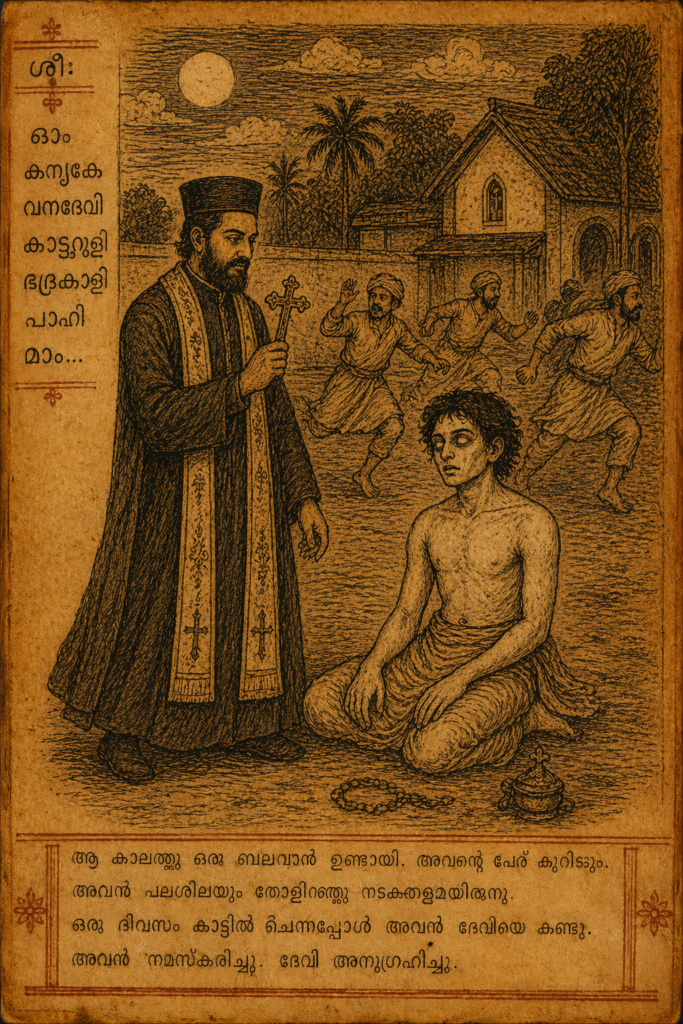
There are things the church cannot explain. Kathanar never tried to explain them. He simply dealt with them.
The monsoon had been particularly heavy that year. The rivers had risen to levels that the oldest people in the Kottayam region could not remember seeing — the Meenachil running brown and fast and angry, spilling over its banks into the lower paddy fields, carrying with it the particular smell of disturbed earth and uprooted things that a flooded river carries. The roads were rivers themselves. Travel was difficult. People stayed close to home.
It was in weather like this — weather that keeps people indoors and makes the nights feel longer and more uncertain than they usually do — that the dead began to walk in Kesavan Nair’s household.
Kesavan Nair was a wealthy landlord from a village three miles east of Kadamattathu. He was a practical man — the kind of man who deals in land and rice and the collection of rents, who has little patience for what he calls superstition and considerable patience for what he calls facts. His household was large: a substantial tharavadu with multiple wings, a compound with cattle and storage buildings, a retinue of servants who had worked for the family for generations.
His son, Govindhan, had been sick for three weeks with a fever that the local vaidyan had been unable to break. The herbs had not worked. The rituals had not worked. The fever had climbed and climbed and on a Tuesday morning in the middle of the monsoon, while the rain hammered the roof tiles and the courtyard flooded ankle-deep, Govindhan died.
He was twenty-two years old.
They prepared the body. They performed the necessary rites. They buried him in the family compound, in the plot where three generations of Nairs lay, under a jackfruit tree that his grandfather had planted.
Three days later, Govindhan was sitting in the courtyard.
Kesavan Nair discovered this at approximately two in the morning, when a sound — not a sound he could identify, just a sound that was wrong, that should not have been there — woke him from sleep and pulled him to the window that overlooked the courtyard.
His son was sitting in the center of the courtyard, in the rain, on the stone bench where the family sat in the evenings. He was wearing the white cloth he had been buried in. He was upright, his back straight, his hands on his knees. His chest was not moving.
Kesavan Nair was a practical man. He stood at the window for a long time, applying every rational explanation he could think of to what he was seeing. None of them worked. The figure in the courtyard was his son. His dead son. Who had been buried three days ago and whose grave, he could see from this window, was undisturbed.
He woke the household. The servants, who came to the windows and the doorways, took one look and left. They did not run — they were too frightened to run — but they walked very quickly to the furthest corners of the compound and did not come back. Kesavan Nair’s wife fainted. His eldest daughter barricaded herself in her room and would not come out.
Kesavan Nair himself stood in the doorway of the main house, looking at the thing that wore his son’s face, for a very long time. He was trying to be a practical man. He was failing.
When dawn came — a grey, waterlogged dawn that did nothing to make the courtyard feel less wrong — he got on a horse and rode to Kadamattathu.
Kathanar listened to everything Kesavan Nair told him. He did not express surprise, which surprised Kesavan Nair more than anything else about the conversation. He asked his questions — the same careful, specific questions he always asked, mapping the situation in the methodical way that was his habit. When had the boy died? What had been the nature of the fever? Had there been any unusual events in the family in the months before the death? Any disputes, any obligations unfulfilled, any promises broken?
This last question made Kesavan Nair shift uncomfortably. There had been a matter — a piece of land, a boundary dispute with a neighboring family that had been resolved in Nair’s favor but perhaps not entirely honestly. He mentioned this with the air of a man mentioning something he would prefer not to be relevant.
Kathanar noted it and moved on.
“What does it do?” he asked. “The thing in the courtyard. What does it do when people come near it?”
“It turns its head and looks at them,” Kesavan Nair said. “Nothing else. It just — looks.”
Kathanar was quiet for a moment. “Its eyes,” he said. “When it looks at you. What do you see?”
Kesavan Nair thought about this. He had looked into his son’s eyes — or what looked like his son’s eyes — once, across the courtyard, before he had gone inside. “Nothing,” he said finally. “I see nothing. Like looking into water.”
Kathanar picked up his bag. “I will come tonight,” he said.
He arrived at the compound after dark, in the rain. The thing that wore Govindhan’s face was still in the courtyard, in the same position it had been in since Kesavan Nair had first seen it. It had not moved in two days. The rain had soaked through the white cloth. The body should have shown signs of decomposition. It showed none.
This confirmed what Kathanar had suspected from Kesavan Nair’s description. This was not Govindhan — not even the remnant of Govindhan, not even his ghost. This was a Brahmarakshasa: the spirit of a learned man, or a man of power, who had died with unfinished business of sufficient weight that his spirit had developed enough force to take up residence in a recently vacated body and use it.
The land dispute. The dishonest resolution. Someone had died wronged, and their wrongness had found a body.
Kathanar stood at the entrance to the courtyard and looked at the thing for a long time. It had not reacted to his arrival. This was information — it knew he was there, certainly, but it was not afraid. It had seen priests before. It had seen holy men before. It was not in the habit of being afraid of them.
“Leave this body,” Kathanar said. His voice was conversational, completely level. Not loud. Not dramatic. The statement of a man who is accustomed to being listened to.
The thing turned its head and looked at him. The eyes were exactly as Kesavan Nair had described — like water, deep and reflecting and containing nothing that a human mind could recognize as a self.
It smiled with Govindhan’s mouth.
What Kathanar did next, he did quickly. Speed matters in these things — not the speed of violence, but the speed of decision, the absence of hesitation, which is the thing that most practitioners of the occult arts lack in the crucial moment and which Kathanar, through years of preparation and direct encounter, had learned to maintain.
He moved into the courtyard. The thing watched him come. It was still smiling. The air around it had the quality that Kathanar associated with very old, very settled presences — a heaviness, a thickness, like air before a storm.
Kathanar did not stop moving. He reached the center of the courtyard, directly in front of the thing, and he put one hand on the thing’s forehead — on the forehead of his dead parishioner’s son — and he spoke.
Not loudly. In fact, nearly silently. But the words he used were specific and they were in a specific order and they carried, behind them, the full weight of everything he knew and everything he was and everything he had prepared himself to be for exactly this kind of moment.
The sound that came from the thing wearing Govindhan’s face was not human. Kesavan Nair, watching from the doorway, would describe it for the rest of his life as the sound of something very large and very angry being forced out of a space it did not want to leave — a sound that seemed to come from everywhere at once and from nowhere at once and that lasted only a second but felt much longer.
Then the body fell.
Not violently. Not dramatically. It simply folded, the way something without internal support folds when the structure that was holding it upright is removed. Govindhan’s body lay in the wet courtyard in the same position it had been buried in — finally, completely, irreversibly dead, the way it had been meant to be three days ago.
Kathanar stood over it for a moment. Then he turned to Kesavan Nair.
“Bury him again,” he said. “This time with iron nails at each corner of the grave. And the matter of the land — ” he paused — “I would suggest resolving it honestly. Not because something will happen to you if you don’t. But because you will sleep better.”
Kesavan Nair nodded. He was not a man who was easily moved, but he was moved.
“Will it come back?” he asked.
“No,” Kathanar said.
He walked home in the rain. He said mass the next morning at his usual time. His congregation noticed nothing different about him.
The grave was re-dug. The iron nails were placed. The land dispute was resolved, quietly, in favor of the neighboring family. Kesavan Nair never spoke publicly about what had happened in his courtyard.
The servants who had left the compound that night trickled back over the following weeks. None of them spoke of it either.
Some things, in God’s Own Country, are better left unspoken.
Kadamattathu Kathanar is one of the legendary figures from Aithihyamala, the great collection of Kerala folklore compiled by Kottarathil Sankunni in the early 20th century.