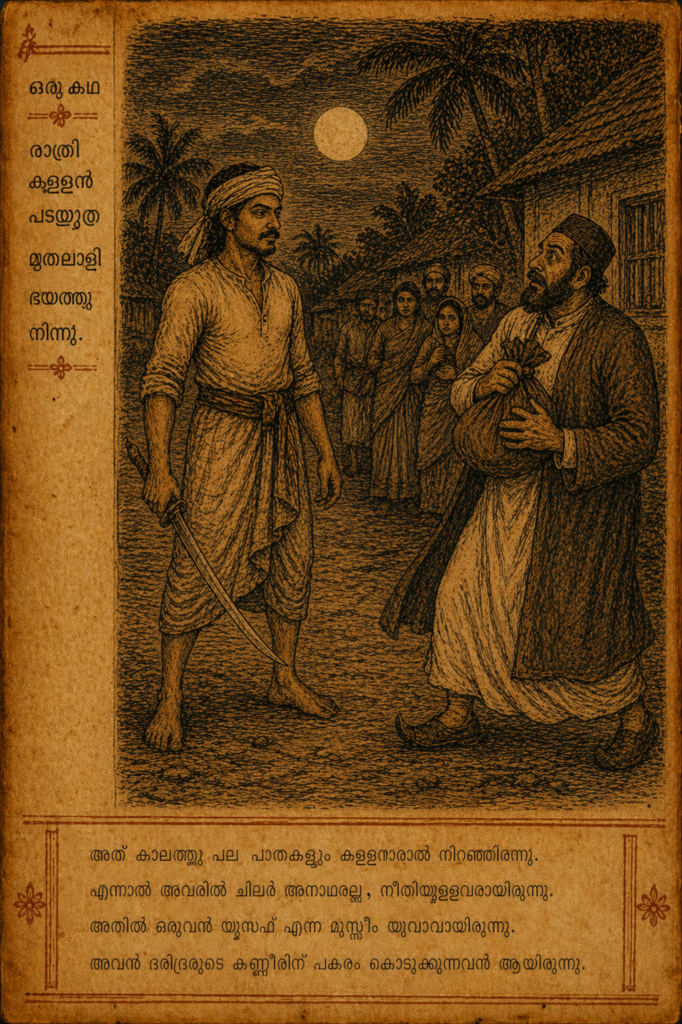
Every rule has an exception. Kochunni’s exception revealed more about him than all his robberies combined.
There is a story about Kayamkulam Kochunni that the ballad singers include only sometimes — usually late at night, when the audience is small and the toddy has been flowing long enough that people are willing to listen carefully rather than just enthusiastically. It is not the most dramatic of the Kochunni stories. There is no chase, no escape, no brilliant misdirection of the authorities. There is only a road, an old man, and a conversation that neither of them forgot.
It is, the singers who include it will tell you, the most important of the stories. Because it is the one that shows you who he actually was.
The monsoon had ended three weeks earlier, and the roads of the Kayamkulam region were in that particular post-monsoon condition — deeply rutted, scattered with debris from the flooding, the laterite mud dried into uneven ridges that made walking treacherous after dark. The coconut palms along the roadside were the particular bright green that follows heavy rain, and the paddy fields were full and still, reflecting what little light came from the overcast sky.
Kochunni was moving south, toward Haripad, on a road he knew well enough to walk in darkness. He had business in that direction — a specific merchant was due to move a specific consignment of pepper along this route, the product of his tenants’ labor priced in a way that would enrich him at their expense, and Kochunni had decided that a portion of that consignment needed to be redistributed before it reached its destination.
He was alone. He often moved alone on preparation trips — the associates came later, when the action itself required more people. Alone, he was just another traveler on a dark road. He had learned, over the years, the art of looking unremarkable: the particular set of the shoulders, the pace, the way of carrying yourself that says nothing to see here to the nervous eye.
He had been walking for about an hour when he heard footsteps ahead of him on the road.
He slowed. Not stopped — stopping draws attention; slowing is merely being cautious. He adjusted his pace to match the pace of the person ahead of him, maintaining distance, observing.
The figure was old. Very old — the walk told you that before anything else, the particular careful placement of each foot that comes with age and with joints that have been rained on for decades. The figure was thin. Carrying nothing but a small cloth bundle and a walking stick of the kind that the poor use — a branch, essentially, stripped and smoothed by use. The sacred thread was visible in the occasional glimmer from behind the clouds: a Brahmin.
Kochunni did a rapid assessment. This man had nothing worth taking. More than that: this man was an old Brahmin walking alone at night on a road with poor footing, which meant this man had somewhere he needed to be badly enough to make a journey that was, for someone his age, genuinely difficult.
He should simply let the man continue. That was the obvious thing.
He was about to slow further and let the gap between them widen when the old man stumbled — not fell, but stumbled, one foot catching a dried rut in the road, and Kochunni watched the small convulsion of effort as the man caught himself on his walking stick and stood still for a moment, breathing.
Against his better judgment — against the instinct that had kept him alive and free for many years, which said that interactions were risks and risks were to be minimized — Kochunni closed the distance.
“Grandfather,” he said. The respectful address, appropriate for an elder. “Are you all right?”
The old man turned and looked at him. His eyes, even in the near-darkness, were remarkable — very clear, very present, the eyes of someone who is accustomed to looking at things directly and without flinching.
“I am fine,” the old man said. “Old bones, old road. They argue sometimes.” A pause. “You are going south?”
“Yes.”
“Then walk with me a little, if you don’t object to slow company.”
Kochunni did not object. He shortened his stride and walked beside the old man, and they went south together in the way that travelers on lonely roads sometimes do — finding in the proximity of another person something that is more than safety, though it is partly safety.
“Where are you going, grandfather?” Kochunni asked after a while. The question was genuine curiosity, not interrogation.
“My daughter’s house, in Haripad,” the old man said. “She is ill. I have been walking since morning.”
Since morning. The distance from where any Brahmin settlement lay, in the direction from which the old man had come, was considerable. He had been walking since morning on arthritic legs on a bad road to reach his sick daughter.
“You should have taken a boat,” Kochunni said. Not a criticism. Just the observation.
“The boat costs money,” the old man said simply. No self-pity in it. Just fact.
They walked in silence for a while. The clouds shifted and there was momentarily enough light to see the road clearly — the paddies on either side, the darkness of the coconut grove to the west, the distant gleam of a temple lamp from somewhere in the direction they were heading.
Kochunni reached into the cloth bag he carried and took out a small purse. It contained coins — silver, taken from a moneylender in Kayamkulam the previous week, a man who charged his borrowers rates that amounted to ownership of their futures.
“Take this,” he said. He held the purse out to the old man.
The old man stopped walking. He looked at the purse. Then he looked at Kochunni.
“I know who you are,” he said.
Kochunni kept his expression neutral. “Most people on this road do,” he said.
“They say you are a criminal.”
“They say many things.”
The old man was quiet for a moment. He looked at the purse in Kochunni’s hand with an expression that was not greed and was not refusal — it was something more considered than either.
“Where does this money come from?” he asked.
“From a man who has too much of it,” Kochunni said. “And who came to have too much of it by making sure other people had too little.”
The old man nodded slowly. He was not shocked. He was thinking.
“In the shastra,” he said — the scriptural texts, which as a Brahmin he had spent a lifetime studying — “there is a concept: aparigraha. Non-grasping. The idea that holding more than you need is itself a form of violence. That the surplus you accumulate is accumulated at the cost of someone else’s sufficiency.”
He took the purse.
“A man who gives,” he said, “is not a criminal. A man who takes without giving — that is the real thief. And this kingdom is full of them. The landlords. The tax collectors. The merchants who weigh with heavy thumbs.” He tucked the purse into his cloth bundle. “You and I, perhaps, are in the same business. We are just using different tools.”
Kochunni looked at the old man for a long moment. In thirty years of operating on these roads, through hundreds of confrontations with merchants and officials and soldiers and informers, nobody had ever said this to him. Nobody had given him, in six words, a framework for what he already believed but had never been able to articulate.
A man who gives is not a criminal.
“Go safely, grandfather,” Kochunni said.
“And you,” the old man said. He continued south toward Haripad and his sick daughter, his walking stick finding the road with the careful precision of long practice.
Kochunni stood on the road and watched him go until the darkness absorbed him.
Those who knew Kochunni well — his close associates, the people who had worked alongside him for years — said that something shifted in him after that period. Not in his methods, and not in his targets, and not in his willingness to act. But in something underneath all of that: a quality of certainty that had not been present before. As if he had, for the first time, articulated to himself what he was doing and why, and found that the articulation was sound.
The ballads remember this story with unusual care — the singers give it more weight than the more dramatic robbery stories, more weight than the escapes and the confrontations with the authorities. Because what it contains, at its center, is something the dramatic stories cannot easily carry: the image of a man who has been given, at the exact right moment, the words for what he already was.
He already knew he was not a criminal. He had always known this, in the wordless way that certain things are known. The old Brahmin on the dark road gave him the words.
A man who gives is not a criminal. A man who takes without giving — that is the real thief.
Kayamkulam Kochunni carried those words for the rest of his life. They are, in a sense, his epitaph — more accurate than anything the colonial court records contain, more permanent than the official verdict of criminal that the Travancore administration stamped on his name.
He gave. That is what he did. He gave, from the surplus of those who had too much, to those who had too little. Whether that makes him a criminal or a saint depends entirely on whose laws you are consulting.
In Kerala, the answer has always been clear.