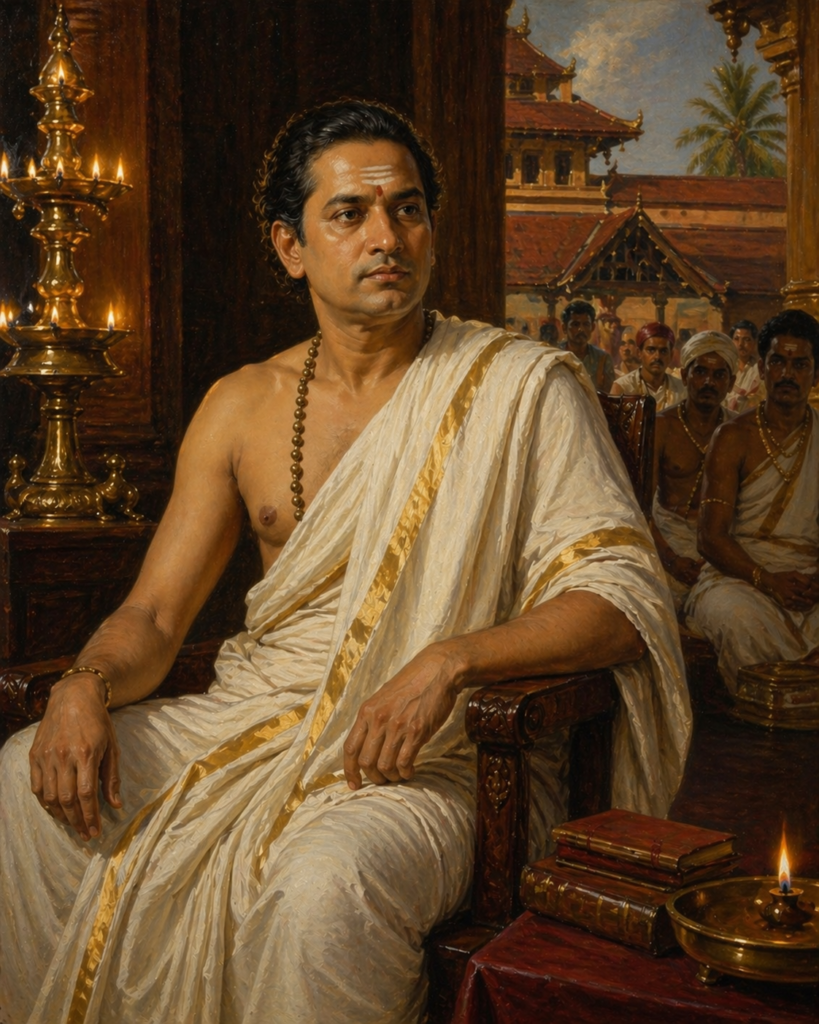
THE BRAHMIN BOY WHO BUILT TRAVANCORE
He started his life as a cook. He ended it as the most powerful Dalawa in Travancore’s history. Between those two points lay the conquest of half a kingdom, the defeat of the Dutch East India Company, and the kind of friendship between a king and a minister that comes once in a century, if at all.
His name was Ramayyan. The honorific Dalawa came later. Much of what Travancore became under Marthanda Varma was, in some essential way, what Ramayyan made it.
——
He was born in 1713 in a village called Yerwadi in the Tirunelveli district of Tamil Nadu, into a Tamil Brahmin family that had no money and no particular prospects. His father was poor in the specific way that Brahmin families could be poor in that era — possessing the dignity of caste and the burden of ritual obligation, but none of the land or income that would make the dignity sustainable.
When Ramayyan was six years old, his father gave up trying to make a life work in Yerwadi. He packed up the family and walked west, into the southernmost part of what would later become Kerala, and settled at a hamlet called Aruvikara in the Kalkulam taluk of the modern Kanyakumari district. About thirty-five miles from Trivandrum. Close enough to be near the centre of things. Far enough that no one was paying attention to a poor Brahmin family adding itself to the population.
For fourteen years, the family lived there. Ramayyan grew up in Aruvikara, three brothers and one sister beside him, learning the Sanskrit and the rituals that a Brahmin boy was expected to learn, with no particular indication that anything unusual was going to happen to him.
Then, when he was twenty, both his parents died.
The accounts do not specify what killed them — fever, probably, the way most people died in that century. What the accounts do specify is what Ramayyan was left with: three younger brothers, one younger sister, no money, no land, no profession, and the weight of being suddenly the head of a household at an age when most men were still becoming themselves.
He had to find work. There was no other option.
——
He became a wanderer. Not a religious wanderer, not a parivrajaka — a man looking for employment. He walked to Trivandrum, the capital of the small Venad kingdom that would later become Travancore, because Trivandrum was where things happened, where festivals brought crowds, where Tamil Brahmins from across the south gathered for ceremonies, and where a young man with the right caste and the right willingness might find someone who needed a servant.
He found work, eventually, as a servant in the household of a wealthy Brahmin in Vanchiyur, a neighbourhood of Trivandrum. Then, by some sequence of small steps that the historical record does not preserve in detail, he moved into the household of the Attiyara Pohtty — one of the prominent Brahmin landowners of the region.
He cooked. He cleaned. He performed the small daily duties that a household servant performed. He was twenty-two, twenty-three years old, with no indication that his life was going to be anything other than what the lives of household Brahmins generally were: a long sequence of small services in the houses of richer men.
——
What changed everything was a dinner.
One evening, around the year 1736, Maharajah Marthanda Varma — the young king of Venad, who had taken the throne in 1729 and was still in the early years of consolidating his power — was dining at the Attiyara Pohtty’s house. The Maharajah was in his early thirties. He had survived the assassination plots of the Ettuveetil Pillamar, the eight noble Nair families who had tried to kill him during his years as a fugitive prince. He had begun the long process of crushing them. He was building something — a kingdom, an army, a bureaucracy and he had developed, in the process, a particular skill: reading people quickly and accurately.
During the dinner, something happened. The historical accounts call it “a minor yet significant incident” they don’t preserve the specifics, the way old accounts often don’t preserve the specifics of small moments that turn out to matter. Some kind of small situation arose during the meal. The kind of situation a household servant would normally be expected to handle.
Ramayyan handled it.
The way he handled it caught Marthanda Varma’s attention. Not because it was dramatic. Because it showed something — a quality of judgment, an intelligence in dealing with the small problem, a manner of attention that the Maharajah had been looking for and had not, until that moment, found.
He asked the Attiyara Pohtty about the young man. He asked who he was, where he came from, what his story was. And then he asked something more direct: would the Pohtty release this servant into his own service?
The Pohtty agreed. There was no real way to refuse.
That night, Ramayyan went home as a servant of the king of Venad.
——
He started small. The Maharajah employed him initially as a cook — the same work he had been doing in the Attiyara Pohtty’s house, just transferred to a more important kitchen. But he did not stay a cook for long.
Within months, Marthanda Varma had moved him into the palace administration. He was given a minor post — junior, peripheral, the kind of role that most servants would consider a promotion and a cap on their ambitions. Ramayyan treated it as a starting point.
He worked. He paid attention. He learned, with the specific intensity of a man who understood that every detail of how a kingdom functioned was something he needed to know. The Maharajah watched him.
By the next year, he was Palace Rayasom — undersecretary of state, the position that handled the daily correspondence and the small administrative matters of the king’s office. This was not a ceremonial promotion. It was the kind of role where a man either succeeded or did not, and the success or failure was visible to everyone who mattered.
Ramayyan succeeded.
——
In 1736, the Dalawa of Travancore — the prime minister, the highest non-royal position in the kingdom — died. His name was Arumukham Pillai. He had served Marthanda Varma through some of the most difficult years of the king’s early reign. His death created a vacancy that needed to be filled, and the choice of who filled it would say something important about the direction the kingdom was going to take.
Marthanda Varma did the unusual thing.
He bypassed the obvious candidates — the senior Nair officials, the established families, the men whose seniority and connections would normally have made them the next Dalawa. He passed over them. And he appointed Ramayyan — a Tamil Brahmin in his early twenties, a former cook, a man who had been in royal service for less than two years — to the highest administrative position in the kingdom.
The decision was not popular among those who had been bypassed. It was not meant to be popular. It was meant to be effective. Marthanda Varma had decided that what Travancore needed was not seniority but capability, and he had identified the capability he needed in this particular young Brahmin.
The decision turned out to be one of the best Marthanda Varma ever made.
——
Ramayyan became Dalawa officially in 1737, after a brief transitional period under Thanu Pillai, the previous Dalawa’s brother. From that point until his death nineteen years later, he was the second most powerful man in Travancore, and on most days the most operationally important.
The work began immediately.
——
The expansion of Travancore — the conquest of the small kingdoms north of Venad that would eventually be welded into the territorial extent of Travancore as we now think of it — happened largely under Ramayyan’s military and administrative direction. He was not just an administrator. He was also a field commander, a man who led expeditionary forces personally, a Brahmin who put aside the traditional Brahmin distance from violence because the work the king needed done required someone who would do it.
In 1731 — even before he became Dalawa — Quilon had been forced into accepting eventual annexation. Then came Kayamkulam, the most stubborn of Travancore’s northern neighbours.
Kayamkulam was rich, well-defended, and allied with the Dutch East India Company and the kingdoms of Cochin, Purakkad, and Vadakkumkur. It would take years to subdue. Ramayyan led expeditionary forces against it personally. He took Nedumangad and Kottarakkara. He pushed northward and was forced back. He came again. And again.
The Kayamkulam war was not a clean war. It was a long, grinding campaign of sieges and reversals, of alliances broken and remade, of villages burned and rebuilt. Ramayyan ran the campaign with the patience of a man who understood that the conquest of a kingdom was not a single battle but a long pressure applied over years.
In the course of the Kayamkulam wars, Ramayyan made a decision that the historical record records with discomfort but also with clarity: he attacked and looted the Nambiathiris, the high-ranking Nampoothiri Brahmin families of Kayamkulam who were also the owners of the temples and the masters of the local Swaroopams.
Killing or looting Brahmins was, in the worldview of the time, something close to spiritual catastrophe. Ramayyan was a Brahmin himself. The decision was not made lightly. But the Nambiathiris had been actively supporting the Kayamkulam resistance, and Ramayyan made the cold calculation that a Brahmin who had decided to function as a soldier had to be treated as one. He attacked them. The temples of the region were brought under Travancore control. The Sree Chakkara Bhagavathy idol of Kayamkulam was removed and reinstalled at Trivandrum — a deliberate act, designed to remove the divine protection that Kayamkulam’s kings had relied on, and to transfer that protection to Marthanda Varma’s capital.
The Nampoothiris of Travancore would never forgive Ramayyan for this. But Kayamkulam fell.
——
The Battle of Colachel in 1741 was the moment that changed everything. The Dutch East India Company, alarmed by Marthanda Varma’s expansion and the threat it posed to their monopoly on the pepper trade, sent a naval force to crush him. The Dutch had defeated every Asian power they had faced for over a century. They expected this to be no different.
It was different.
The battle is its own story — fought primarily on the western coast, with the Travancore forces using guerrilla tactics, surprise, and the local geography to neutralize the European technological advantages. Marthanda Varma led the forces personally. Ramayyan was central to the strategic planning, the supply lines, the political coordination that made the campaign possible.
The Dutch were defeated. Their commander, Admiral Eustachius De Lannoy, was captured. It was the only time in that era that an Asian power decisively defeated a European naval force.
Ramayyan, in the aftermath, helped organize the integration of De Lannoy into Travancore’s service. The captured admiral became, eventually, the Valiya Kappitan — the great captain — who would modernize Travancore’s army along European lines. Ramayyan’s diplomatic and administrative work in this integration was substantial. He understood that what Marthanda Varma needed from De Lannoy was not vengeance but service.
——
The administrative reforms came in parallel with the military campaigns. Ramayyan was not just a war minister. He was a builder of systems.
He reformed the tax structure. He introduced revenue monopolies — pepper, salt, tobacco, and other commodities — that made Travancore one of the richest small kingdoms in India. He drafted a series of edicts and orders called the “Ramayya Sattams” that became the basic legal framework of Travancore’s commerce and excise for the rest of the century. He oversaw the construction of the Trivandrum fort, the Sheevelipura precinct around the Padmanabhaswamy temple, and the royal palace within the fort.
Some of his reforms were not just. He imposed a poll tax on lower castes that the historical record records as a clear injustice. He was, in this respect, a man of his time and his caste, and he did not transcend the social order he had been born into. But he did, undeniably, build something that lasted.
——
By 1745, Marthanda Varma was sick. The illness — never specified in detail in the records, but persistent and worsening — made him increasingly reliant on Ramayyan to handle the day-to-day operation of the kingdom.
This was the period when Ramayyan’s power was at its height. He was running Travancore in everything but the formal sense. The king was alive, but the work was largely Ramayyan’s.
There is a famous legend from this period — historically uncertain, but consistent enough across sources to suggest something real lay behind it. Marthanda Varma, the legend says, offered Ramayyan half the kingdom. Outright. To rule as a king himself. The offer was the kind of gesture that Indian kings sometimes made to ministers of unusual capability and unusual loyalty.
Ramayyan refused.
His reason, as the legend records it, was specific: he was a Brahmin. Ruling was the work of Kshatriyas. He would serve. He would not rule.
The refusal is the kind of thing that defines a man. Ramayyan understood that his power existed because of his service, and that converting service into rulership would change something he was not interested in changing. He stayed where he was.
——
In January 1750, Marthanda Varma performed the Trippadidanam — the ceremony in which he formally dedicated the entire kingdom of Travancore to Lord Padmanabha, the deity of the Padmanabhaswamy temple. From that moment forward, the kings of Travancore ruled not as kings in their own right but as Padmanabha Dasa — servants of the deity. The kingdom belonged to Vishnu. The king was just the manager.
Ramayyan was central to the planning of this ceremony. He was also central to what came next: the move of the commercial and administrative apparatus of the kingdom to Mavelikkara, where the natural produce of the kingdom was concentrated. Ramayyan moved there himself. Marthanda Varma had a palace built for him in Mavelikkara — a recognition of what Ramayyan had become to the kingdom.
His personal life had its own complexities. His first wife had died years earlier. He married a Malayala unnithan lady from the Edassery family of Mavelikkara — a local marriage that integrated him into the community he was now governing from. After his death, she would be granted gifts and special allowances by the Travancore government in recognition of his services, and his descendants by his first marriage would later resettle in Pudukkottai in Tamil Nadu, where the king of Pudukkottai gave them the entire village of Sithanavasal in honour of Ramayyan’s name.
——
He died in 1756. He was forty-three years old.
The cause is not specified clearly in the records, but he had been ill, and his death was not unexpected. What was unexpected was the depth of Marthanda Varma’s reaction.
The Maharajah did not just mourn. He broke. The man who had survived the Pillamar conspiracy, the years on the run, the wars of consolidation, the Dutch invasion — the man whose composure under pressure was legendary — collapsed when he heard of Ramayyan’s death. He fell into a depression that he never recovered from. His health, already poor, declined sharply. Two years later, in 1758, he followed his Dalawa into death.
It was understood by everyone who watched both men in those final years that Marthanda Varma did not simply outlive Ramayyan. He outlived him reluctantly, and not for long.
——
On his deathbed, Ramayyan was asked how he wanted his memory perpetuated. The question was the kind of question that important men in that world were asked at the end — a chance to design their own legacy, to specify what monuments or honours they wanted, what families they wanted elevated, what permanent structures they wanted built in their name.
Ramayyan’s answer is preserved word for word in the records of Travancore:
“I was an instrument in the hands of my master. I had no such ambitions.”
——
This is the line, in the end, that the historical record has chosen to remember him by. Not the conquests. Not the reforms. Not the defeated Dutch or the integrated De Lannoy or the conquered Kayamkulam.
The line of a man who understood, more deeply than most men of power ever understand, that he had not built Travancore for himself.
He had built it because Marthanda Varma had pulled him out of a kitchen in 1736 and given him a chance, and the rest of his life had been the long working out of his answer to that chance.
The kingdom they built together lasted until 1949. The Padmanabhaswamy temple still stands. The fort at Trivandrum still stands. The administrative systems Ramayyan designed shaped Kerala for two centuries.
He was forty-three when he died. He had served his king for nineteen years.
It was, by any honest measure, enough.