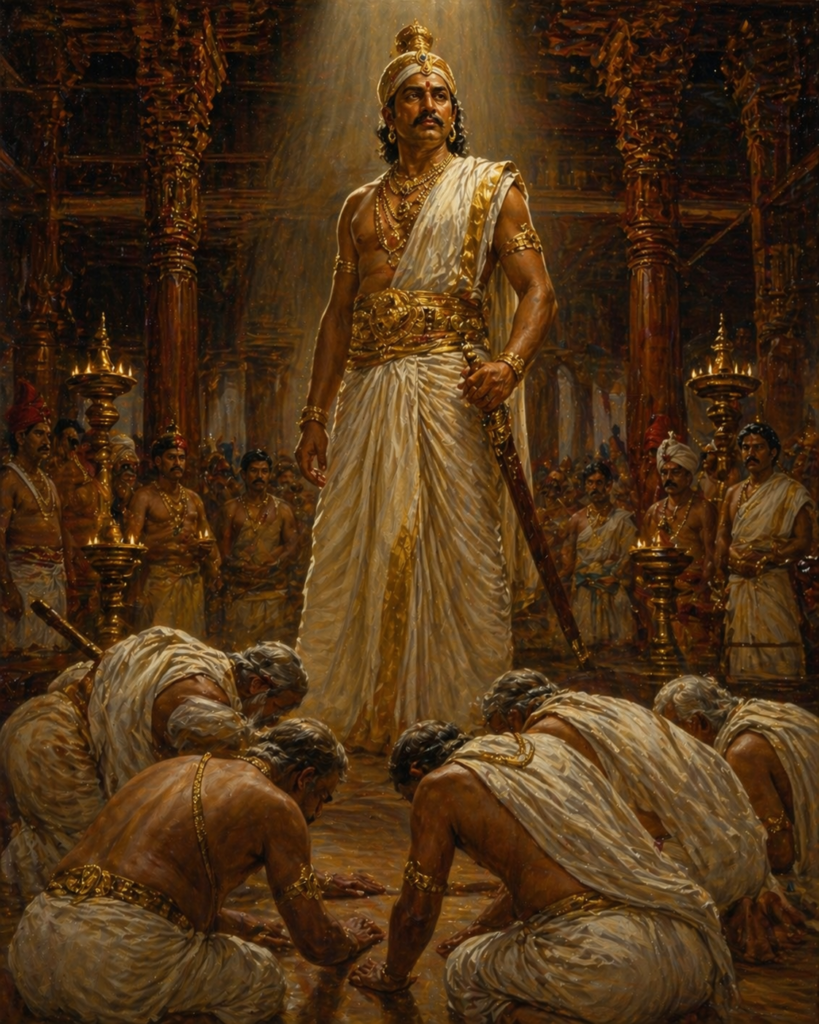
The kingdom he was born into barely qualified as a kingdom. The kingdom he died ruling was the most powerful state on the Malabar coast.
Between those two points was fifty-two years of work. The work began before he was crowned and did not end until the day he died. It involved more conspiracies than a man should have to survive, more wars than a kingdom that small should have been able to fight, and one moment in 1741 when he changed the calculations that European powers had been making about Asia for two centuries.
His name was Anizham Thirunal Marthanda Varma. The people who lived through his reign called him many things — some affectionate, some terrified. The historians who came later called him the founder of Travancore.
He was born to do this. The records make that clear. He was born to be exactly what he became.
——
He was born in 1706 in Attingal, in a small Kerala kingdom called Venad. His mother was Karthika Thirunal Umadevi, the Junior Queen of Attingal — a woman who had been adopted into the Travancore royal house from the Kolathunadu kingdom in the north because the Venad royal line had run out of female heirs and the matrilineal succession of Kerala required women to carry the dynasty forward. His father was Raghava Varma, of the Kilimanoor royal family, a collateral branch of the Travancore royals that would later produce, among others, the painter Raja Ravi Varma.
His father died of fever when Marthanda Varma was one year old. He grew up without a father.
He grew up in a kingdom that was barely surviving. Venad in 1706 was a small principality stretching from Attingal in the north to Aralvaimozhi at Cape Comorin in the south. Its kings ruled in name only. The actual power was held by a coalition of eight powerful Nair families called the Ettuveetil Pillamar — the Lords of the Eight Houses — who had spent generations weakening the royal authority and accumulating real control over the land, the troops, and the revenue. The Ettara Yogam — the eight and a half member council that managed the Padmanabhaswamy temple — was equally powerful, equally hostile, and worked in coordination with the Pillamar to keep the kings impotent.
The history of Venad’s royal house in the century before Marthanda Varma was a history of murders. The previous king Aditya Varma had been assassinated. Five sons of an earlier queen, Rani Umayamma, had been drowned in the Kalippankulam pond as boys, almost certainly at the instigation of the Pillamar. The royal house had been so thoroughly attacked that members had to be repeatedly adopted from outside families just to keep the dynasty alive.
This was the world Marthanda Varma was born into. A throne that had been hollowed out from beneath. A family that had been targeted for extinction across multiple generations. A network of nobles and Brahmin trustees who treated the king as a ceremonial inconvenience to be tolerated, manipulated, or — when necessary — killed.
He was paying attention from the start.
——
The accounts of his early life describe a boy who was not normal in the way that boys his age were normal. He was tall — by adulthood he stood six and a half feet, an extraordinary height for the time and place — and his hands were said to reach below his knees. He had a commanding physical presence that people noted from his childhood. But the real difference was inside.
He was studying. He was watching. He was learning, with the specific intensity of a child who understands that his survival depends on understanding the people around him, who the threats are, what the patterns are, where the weaknesses lie.
By the time he was fourteen, he was traveling the kingdom in disguise. Not for adventure. For information. He wanted to see how the people lived, who held the real power in each region, where the loyalties were and where they were not. He was building, in his head, the kingdom he would one day inherit.
In 1723 — when he was seventeen — he signed a treaty with the British East India Company, styling himself as the “Prince of Neyyatinkara.” This was a serious political action by a man not yet old enough to be king. It enraged the Ettuveetil Pillamar, who understood, correctly, that a prince capable of independent diplomacy with foreign powers was a future king they would not be able to control.
In 1726, when he was twenty, he advised his uncle Rama Varma to sign a treaty with the Madurai Nayaks, bringing Tamil mercenary forces into the country to check the activities of the Pillamar. This was a clear declaration of intent. The Pillamar understood it. They began planning to kill him.
He went on the run.
——
The years between 1721 and 1729 were the years of the wandering. Marthanda Varma, the heir apparent to the Travancore throne, lived as a fugitive in his own kingdom — moving from village to village, sleeping in different houses each night, never staying long enough to be located, supported by a small group of loyal companions including a Namboothiri Brahmin and a Nair named Kochiravi Pillai.
The legends from this period are dense. They have the quality that legends acquire when something remarkable actually happened — not invented heroism, but real survivals that the people who witnessed them turned into stories because they could not be contained as facts.
The most famous of these is the story of Ammachi Plavu — the Mother Jackfruit Tree.
He was being chased. The Pillamar’s men had picked up his trail at the banks of the Neyyar river. He had crossed the river by boat. He had hidden in thorny bushes. The hiding was not working. They were close.
He prayed to Lord Padmanabha — the deity at the centre of his family’s religious life — for help.
A boy appeared. A young cowherd, in a place where there should not have been any boy. The boy showed him a jackfruit tree with a hollow trunk, large enough to hide a person inside. Marthanda Varma climbed in. The boy disappeared.
The pursuers ran past. Marthanda Varma stayed in the tree until they were gone. When he climbed out, the boy was nowhere to be found. He came to believe — and his contemporaries came to believe — that the boy had been Lord Krishna himself, intervening to save the future king of Travancore.
Years later, when he was on the throne, he built a Krishna temple at that exact spot. The Neyyattinkara Sree Krishna Swamy Temple still stands today. The hollow trunk of the jackfruit tree, called Ammachi Plavu — the Mother Tree — was preserved and is still kept in the temple precinct, protected by the Kerala State Department of Archaeology. Every king of Travancore after Marthanda Varma visited the tree and the temple before their coronation, to seek the blessing of the tree that had saved the founder of their dynasty.
There were other escapes. He hid in the dense forests. He took refuge in the dark cellars of the Padmanabhapuram palace. He was sheltered, at one point, in the Nellimoottil Tharavadu — a Syrian Christian household in Adoor — by an old grandmother named Oonnoonniamma, who fed him without knowing who he was and whose family the king would, decades later, summon to court and reward.
He survived all of it. The Pillamar never managed to kill him.
By 1729, when his uncle King Rama Varma died, Marthanda Varma was twenty-three years old. He had been hunted for almost a decade. He had survived. And now the throne was his.
——
The throne came with nothing on it. The treasury was empty. The army was unpaid and rebellious. The Tamil mercenary troops his uncle had brought in were demanding to be paid before they would acknowledge the new king’s authority — and when they were not paid, they kidnapped Marthanda Varma’s prime minister Arumukham Pillai and held him hostage. Marthanda Varma, who would not negotiate with troops who had taken his minister, sent a force and freed the Dalawa by violence.
The treasury had no money to pay the Pandyan army stationed in Travancore — three thousand rupees was due annually to the king of Trichinopoly under an earlier agreement. Marthanda Varma made a calculation that few rulers in his position would have made: he sent the Pandyan army back. He paid them off, sent them home, and decided that Travancore would defend itself with its own troops or not at all.
It was the right decision. The money he saved went into building roads, anicuts, irrigation canals, and markets. The fertile lands of his kingdom started producing two crops a year instead of one. State revenue began to climb.
But the Pillamar were not finished.
——
There is a problem with sons of dead kings in matrilineal societies. Their fathers are kings, but the matrilineal succession of Kerala did not pass through fathers. It passed through sisters’ sons. So the sons of King Rama Varma — known as the Thampi brothers, Padmanabhan and Raman — were, by tradition, not eligible for the throne. Their cousin Marthanda Varma, the son of the king’s sister, was.
The Thampis did not accept this. With the support of the Ettuveetil Pillamar, they raised a claim to the throne under the older patriarchal succession. They went to the Pandya king of Trichinopoly. They asked for an army.
The Pandya king sent an army under a commander named Alagappa Mudaliar. The Pandyas had their own grievances — overdue royalty payments — and they were happy to back a claim against Marthanda Varma.
This is where Marthanda Varma’s diplomatic skill showed itself fully. He could not afford a war with the Pandyans at this stage of his reign. So he met with Mudaliar personally. He produced records. He explained, with documentation, why the matrilineal succession was the legitimate one. He gave Mudaliar substantial gifts. And he convinced him, in the end, to switch sides — the Pandyan commander left a battalion of cavalry and two battalions of infantry with Marthanda Varma when he marched home.
The Thampi brothers were left without their army.
In 1733, Padmanabhan Thampi and Raman Thampi tried one last thing. They came to the Nagercoil palace where Marthanda Varma was staying. They tried to enter without being announced. The guards stopped them. A sword fight broke out at the gate. Padmanabhan was killed by the guards there. Raman pushed through and stormed into the king’s chamber, sword raised, swinging.
The sword struck the ceiling.
Marthanda Varma — who had been waiting for exactly this kind of attack, who had been ready for it the way a man is ready for the thing he has spent his life expecting — pulled out the dagger he carried at all times and drove it to the hilt into Raman Thampi’s heart.
Then he walked to the window and gave a signal to his men outside.
By morning, every member of the Pillamar conspiracy across Travancore had been rounded up and brought before him. Forty-two of them. They were hanged in public. Their houses were dismantled — Kulamthondal, the punishment of having one’s home dug up — and their lands and assets were confiscated. The wood and stone from their palaces was carted to Trivandrum and used to build Marthanda Varma’s own constructions, including the Ramanamadhom and Thevarathu Koikal palaces. Their women and children were sold to the Mukkuvar fishermen of the coast, in the cruel calculus of that time.
The Ettuveetil Pillamar were finished. Two centuries of noble obstruction of the Travancore royal house ended in a single morning.
——
What he did to the Pillamar set the tone for what followed. Marthanda Varma was not a vengeful man, exactly — he had no personal cruelty in him — but he had absolute clarity about what kingship required, and what it required was that no one in his kingdom should be able to challenge him and survive. He extended the same logic outward. Over the next several years, he destroyed the power of more than seventy other noble families across Venad. The Ettara Yogam — the temple council that had worked with the Pillamar for so long — was dismantled and replaced. The administration of the Padmanabhaswamy temple was brought directly under royal control. The Yogakkars and the Brahmin families that had supported the Pillamar were expelled from Venad.
By the late 1730s, there was no power in the kingdom that could challenge him.
He turned outward.
——
The expansion of Travancore took twenty years. It began with the small chiefdom of Quilon, just north of Venad, ruled by a branch of the same Venad royal family. In 1731, the Quilon king was forced into a treaty that would allow Travancore to annex his kingdom upon his death. The king of Quilon was rescued briefly by the kingdom of Kayamkulam, but in the end, after years of fighting, Quilon fell.
Then Kayamkulam itself.
Kayamkulam was the most stubborn of Travancore’s northern enemies. It was wealthy. It was well-defended. It was allied with Cochin, with Purakkad, with Vadakkumkur, and — crucially — with the Dutch East India Company, which understood that a Marthanda Varma in control of the pepper-growing northern principalities would be a disaster for Dutch commercial interests.
The wars of consolidation lasted from the early 1730s into the 1740s. Battles at Nedumangad. Sieges at Kottarakkara. The conquest of Kollam. Eventually Kayamkulam fell. Then Marta. Then Tekkumkur, Vadakkumkur, Pandalam, Ambalapuzha, Kottayam, Changanassery, Meenachil, Karappuram, Alangad. The map of Travancore that we recognize today — the long coastal strip from Aralvaimozhi to the borders of Cochin — was assembled in those years, principality by principality, war by war.
Through all of it, Marthanda Varma led from the front. He had instructed himself in warfare from boyhood. He knew the geography of his kingdom in detail. He commanded with the specific quality of a man who had been a fugitive in this same landscape for years, who knew where every river crossed and where every forest hid an ambush.
His Dalawa Ramayyan handled the administrative side, the campaigns when the king could not be present personally, the relentless work of building a kingdom while another part of the kingdom was still being conquered. Together they were unstoppable.
——
The Dutch were watching all of this with growing alarm.
The Dutch East India Company had spent over a century establishing itself as the dominant European power in the Indian Ocean. It had defeated the Portuguese. It had built fortifications across the spice-producing regions. It had treated Indian rulers as junior partners at best, and as obstacles to be removed when necessary. It had never lost a major naval engagement to an Asian power.
In 1741, the Dutch sent a battalion from Ceylon to land at Kolachel beach on the Travancore coast and put an end to Marthanda Varma’s expansion. They were confident. They had no reason not to be. They began looting houses and markets along the coast, attacking Travancore positions, preparing to march on Trivandrum.
The Battle of Kolachel was fought on August 10, 1741. Marthanda Varma led a Travancore army against the Dutch force. Ramayyan’s cavalry broke into the Dutch infantry formations and shattered them. The Dutch were not just defeated — they were routed. Their commander, Admiral Eustachius De Lannoy, was captured.
It was the only time in that era that an Asian power decisively defeated a European naval expedition. It changed the calculations European powers made about whether they could simply impose their will on Indian states. It marked the limit of what the Dutch could do in India. After Kolachel, the Dutch never recovered their position on the Malabar coast.
What Marthanda Varma did with De Lannoy was, in some ways, more remarkable than the victory itself. He did not execute him. He did not ransom him. He spared him, and then offered him service. The captured Dutch admiral became, in the years that followed, the Valiya Kappitan — the Great Captain — and modernized Travancore’s army along European lines. He served Marthanda Varma loyally for the rest of his life. He is buried in Travancore.
That kind of decision — the decision to look at a defeated enemy and see a useful man, the decision to convert a victory into a long-term asset — was characteristic of Marthanda Varma at his best. He did not waste people. He extracted from every situation, including military victories, the maximum future utility.
——
By 1745, Marthanda Varma was sick. The illness was not specified clearly in the records, but it was persistent and worsening, and from this point forward he relied increasingly on Ramayyan to handle the daily operations of the kingdom.
In 1750, he made the most unusual decision of his reign.
He performed the Trippadidanam — the ceremony of dedication. He formally surrendered the entire kingdom of Travancore to Lord Padmanabha, the deity of the Padmanabhaswamy temple. From that moment forward, the kingdom did not belong to the king. It belonged to Vishnu. Marthanda Varma, and every king who succeeded him, ruled not as king but as Padmanabha Dasa — servant of Padmanabha. The royal title became a managerial title. The wealth of the kingdom was the wealth of the deity.
It was a theological act and a political masterstroke. By making the deity the formal owner of the kingdom, Marthanda Varma made it impossible for any future ruler — or any future invader — to claim the kingdom as personal property. The kingdom was sacred. The king was just the manager. To attack the kingdom was to attack the god.
This worked. It worked for two centuries. The Trippadidanam framework held the kingdom of Travancore together through every challenge that came afterward — Mysore’s invasions under Hyder Ali and Tipu Sultan, the British East India Company, the political turmoil of the late eighteenth and nineteenth centuries. The kingdom belonged to Padmanabha. The kings ruled in his name.
——
He built the Padmanabhaswamy temple in essentially the form we know it today. He built the fort around it. He built the palace within the fort. He built roads and canals and markets across the kingdom. He extended patronage to the Syrian Christian merchant communities, deliberately, as a way of building a counterweight to European trade dominance. He survived smallpox, which killed many around him. He outlived the Ettuveetil Pillamar, the Thampi brothers, the Dutch admiral who had come to crush him, and most of his own generation.
In 1756, Ramayyan died.
The Maharajah did not recover from this. He had survived all his enemies. He could not survive the death of his friend. His health, which had been declining for years, collapsed entirely. He fell into the kind of grief that older men sometimes fall into when the person who has been beside them for half a lifetime is gone, and there is no one left who knew them when they were younger.
Two years later, on July 7, 1758, he died. He was fifty-two years old.
Before his death, he summoned his nephew and successor Karthika Thirunal Rama Varma — who would rule as Dharma Raja — and gave him three final instructions. Maintain all the poojas and ceremonies of the Padmanabhaswamy temple, without attempts to interfere with them. Never allow the expenses of the state to exceed its revenue. And never allow infighting within the royal family.
These instructions, kept by his successors, held the kingdom together for the next two centuries.
——
The kingdom Marthanda Varma built lasted until 1949, when Travancore acceded to the Indian Union after Independence. The royal family still exists. The Padmanabhaswamy temple still stands, with vaults full of treasure that the kings of Travancore accumulated as servants of the deity, treasure that was not opened until 2011 and whose full value remains the subject of debate.
The Ammachi Plavu — the hollow jackfruit tree that hid him when he was a hunted boy — is still preserved at the Neyyattinkara Krishna temple. People still visit it. Children still place their hands inside the hollow where he once climbed in to escape his death.
He had been hunted. He had survived. He had built. And what he built outlasted him by two hundred years.
That is more than most kings ever achieve. Most kings, in fact, do not even come close.
He started with nothing. He died as Padmanabha Dasa. The man who had been a fugitive in his own kingdom became the founder of one of the longest-lasting native states in the history of India.
He did this without inheriting power. He did this by surviving. He did this because he was, from the earliest age the records preserve, exactly the man this work required.
The records do not say whether he ever rested. The records do not suggest that he did.