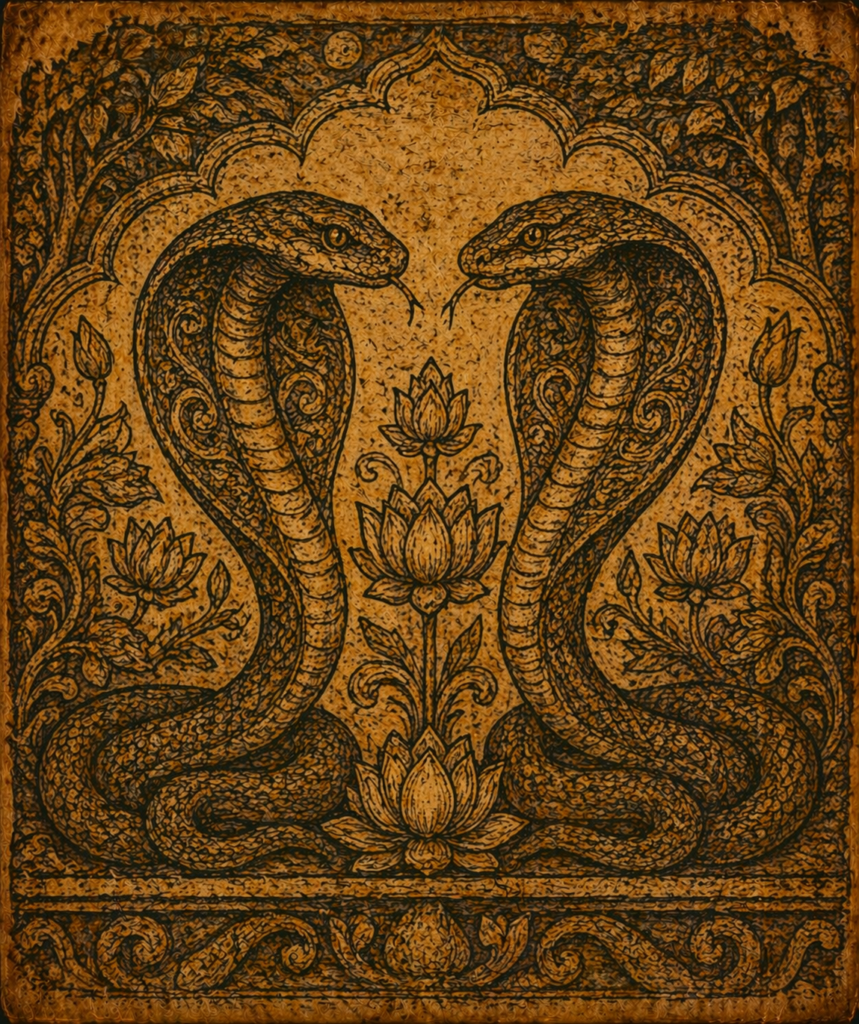
A Father, A Daughter, and the Old Memory of Kerala
The Chapter 1: ANANTA — The Endless OneCorner
The pooja had begun before sunrise.
By the time the girl came out into the nadumuttam, the central courtyard, her grandmother was already at the sarpakavu. The smell of camphor was thick on the air. A small clay lamp burned at the base of the stones. The white of fresh milk sat on a banana leaf at the foot of the Nagaraja idol, catching the first grey light of morning.
The girl stood at the edge of the courtyard and watched. Seven years old. Hair still wet from her bath. The pavadai her grandmother had laid out for her clung slightly to her ankles where the floor was damp.
Her grandmother’s lips were moving. The words were old, older than the Malayalam the girl had learned in school, older than the Malayalam her father spoke at the dinner table. The words had a sound the girl could not quite catch, the way water has a sound that you can hear but cannot repeat, the way wind in old trees has a sound that you cannot put into letters.
The girl watched until the prayer ended. Her grandmother rose from where she had been kneeling, performed the final bow toward the four old trees of the grove, and walked slowly back across the courtyard toward the kitchen. She passed her granddaughter without speaking, not from coldness, but from the particular silence that surrounds a woman who has just finished speaking with something other than people.
The girl did not move.
She kept looking at the corner. At the four trees with their roots tangled together underground. At the dark stones inside the trees, the worn granite of Nagaraja and his consort. At the milk on the banana leaf, white in the grey light. At the lamp still burning.
After a long moment her father came and stood beside her. He had been at the kitchen door, watching her watch.
“What are you thinking, moley?”
She did not look up at him. She kept looking at the corner.
“Achaa,” she said, “why does Ammachi do pooja for a snake?”
He did not answer. Not at first.
The grey light was lifting. Somewhere beyond the compound a kokku called once and went silent. The first sunlight caught the top of the plavu tree at the eastern wall and turned the wet leaves bright for a moment before fading.
“Come and sit,” he said.
He led her to the thinna, the long verandah platform along the eastern wall. She climbed up. He sat beside her. From here they could see the entire compound, the kitchen on the west side, the well in the south, the sarpakavu in the southwestern corner with its four old trees still wet with the night’s rain.
“You really want to know?” he asked.
She nodded.
“It is a long story,” he said.
“I have time.”
He smiled at this. Children always think they have time. He had thought he had time too, when he was her age, sitting in this same place asking these same questions of his own father.
“All right,” he said. “But first, look at the corner. Look at it carefully. Tell me what you see.”
She looked. “Trees. Stones. Milk. The lamp.”
“Anything else?”
“The kavu.”
“Yes. The kavu. That is what we call it. The serpent grove. Now I want you to understand something before I tell you the rest. That corner of our compound, that small patch of land with the four trees, has been there longer than this house. The house was built around it. Your great-great-grandfather, who built the first part of this tharavadu, did not put the kavu there. The kavu was already there. He built the house in the only place that respected the corner.”
The girl turned her head to look at him.
“And his father didn’t put it there either,” her father continued. “Or his father. Or his father. As far back as anyone in our family can remember, the kavu in that corner has been there. Older than the family. Older than the village. Older than anything we can count.”
“How can something be older than counting?”
“That is what I am going to tell you about.”
SHESHA — The Remainder
You have to understand that this land is not normal land.
Not in any geological sense the schoolbooks would teach. In a different sense. The Kerala you and I live on, this thin green strip between the Sahyadri mountains and the Arabian Sea, is, according to the oldest stories of our people, not the original land. It was made. It was reclaimed. It came up from somewhere it had not been before, and the way it came up was not the ordinary way.
You know Parasurama?
The girl nodded. She had learned about him in school. The avatar of Vishnu who carried the axe.
He was a fierce one, Parasurama. The stories say he killed all the wicked kings of the earth, twenty-one times, the texts say, though no one knows what twenty-one times means in a story that old. After all the killing was done, he understood that he had taken something from the world that he could not give back. He went to the great Brahmin sages and asked what he could do to atone. They told him: give land to the priests. Land is the offering that washes blood from the hands of warriors.
But Parasurama had no land of his own. He had taken from kings, but the land of kings was still the land of kings. He needed to make new land. Land that was his to give.
So he stood on the top of the Sahyadri mountains, at Gokarna in the north, and he threw his axe westward into the sea.
The sea pulled back.
Where the water had been, land was. Green, fresh, new land, running south all the way to Kanyakumari, where the three seas meet. He had reclaimed it from the ocean. It was his. He gave it to the Brahmins.
This is what the Keralolpathi says. The Keralolpathi is an old book, moley, written down in the seventeenth century, but it tells stories that were already old when the writing began. It is one of the foundational texts of Kerala. It tells how this land came to be. Parasura-Kshetra. The land of Parasurama. The avatar’s gift.
But here is the part that the schoolbooks usually leave out.
When the sea pulled back, the land was not empty.
Someone was here.
The girl was very still. The sun was beginning to come over the eastern wall now. The mist that had hung over the field was starting to thin.
“Who was here?”
“The Nagas.”
“What are Nagas?”
He thought for a moment about how to answer this.
“Moley, the Nagas are, they are not just snakes. The way our people understood them, the Nagas were a kind of being who could take the form of a snake or the form of a person, depending on what was needed. They lived underground, in a place called Patala. Their cities were in the deep earth. Their walls were made of jewels. Their king was Vasuki, a great serpent so large his coils could circle a mountain. Their queen had many forms in many stories. They were not human. They were not animals. They were something older than both. Something that was here before.”
“Before what?”
“Before everything. Before the kings. Before the temples. Before Parasurama. The Nagas were already in the land when the land first came up out of the sea. Or, and this is what some of the old people say, the Nagas had been here even before that. Before the land was land. Under the sea, in their cities of Patala, while the salt water moved overhead. And when the sea pulled back and the land came up, the Nagas were the first to stand on it. They watched the green grow. They watched the trees come. And then Parasurama came down from the mountains with his axe and his vow to give the land to the Brahmins, and the Nagas watched him too.”
“Were they angry?”
“They had a right to be. The Keralolpathi says they attacked. The Brahmins who came to settle were bitten. Some died. The Nagas were defending what they considered theirs.”
“What did Parasurama do?”
“This is where the story turns, moley. Parasurama did not fight them. He could have. He had the axe. He had killed the Kshatriyas of the world twenty-one times. He could have tried to do the same with the Nagas. But he did not. He understood something. He understood that the Nagas were not like the kings he had killed. The kings were proud. The kings were greedy. The kings could be removed and the world would continue. But the Nagas were of the land itself. They were the land. To remove them would be to remove the land. So he did something different.”
“What?”
“He went to Shiva.”
VASUKI — The Throne
The story says Parasurama climbed back up into the mountains. He found Shiva in the high places where Shiva sometimes is. He bowed before him. He said: I have made this land. I have given it to the priests. But the land cannot be theirs alone. The Nagas were here first. They will not leave. They will not allow the priests to settle in peace. Tell me what to do.
Shiva, the stories say, did not answer for a long time. When he answered, he said only this.
Go to Patala. Speak to Vasuki. The promise is not yours to make alone. It is yours to make with him.
So Parasurama went down. Into the underworld. Into the place where the Nagas lived. The stories do not tell us how he got there. The stories never tell us how mortals get into Patala. They just tell us that he did. He arrived in the city of the serpents. He stood before the throne of Vasuki, the king of all Nagas, the great serpent whose coils could circle a mountain.
And he asked.
He asked for a promise. He asked for peace between his people, the people he had brought to settle the new land, and the Nagas who had been there before. He asked them to share.
Vasuki listened.
The girl was leaning forward. The morning was full now. Her grandmother had come back into the courtyard and was sweeping the area in front of the sarpakavu with a small chooral broom. The sound of the broom, the soft whisper of grass on stone, carried across the courtyard.
“Did Vasuki say yes?”
“Yes. But not for free. Not without conditions.”
“What were the conditions?”
“This is the heart of the story, moley. This is what I want you to remember. Vasuki said: we will leave the open ground. We will stop attacking the people who come to settle. We will give them the land to walk on, the land to plant, the land to build their houses. But we will not leave entirely. We cannot leave entirely. This land is ours too. It is the surface of our world. We are connected to it. So we will go into the holes in the earth and the burrows beneath the trees. We will make ourselves smaller. We will not be seen. We will not bother the people who come.”
“And in return?”
“In return, and this is the promise, the people who come must not forget us. They must give us a corner. In every house. In every compound. A small piece of ground where we can still come up. Where we can be present. Where they can leave us food and water. Where they can remember that we are here, that we were here first, that the land they walk on was given to them by us.”
He looked at the kavu in the southwestern corner.
“That,” he said, “is what that is. The corner of the promise. Not just our family’s corner. Every traditional Nair household in Kerala has this corner. Every old tharavadu you visit, look in the southwestern corner, you will find a kavu. Some are big, with whole groves of trees. Some are small, with just one or two stones under a single old tree. But they are all the same corner. They all hold the same promise. They have all been there since the first families settled in this land and made their promise to the Nagas who allowed them to stay.”
“And the Nagas, they actually live in the corners?”
“Some say yes. Some say it is only a symbol. Some say the Nagas moved on long ago and only the memory remains. But the families who maintain the corners, they will tell you that something is still there. That on certain days, you can feel it. That on certain mornings, when the pooja is performed correctly, you can sense that someone has come up to receive what is offered. That the corner is not empty. That it has never been empty.”
KARKOTAKA — The Healer
There is another part of the story, moley. The most important part. Because if you only knew what I have told you so far, you would think the Nagas simply agreed and went back underground and have stayed there since. But that is not the whole story. The whole story is more wonderful than that. The whole story is the reason the Nagas are not just our memory but our partners.
The land Parasurama had reclaimed from the sea was barren.
Salt. The sea had soaked it for so long that nothing could grow. The Brahmins he had brought to settle could not plant rice. They could not plant coconut. They could not feed themselves. They came to him and complained. They said: you have given us a beautiful land but a useless one. We cannot live here.
Parasurama went back to Shiva. Once again, the great teacher told him: go to Vasuki. The same answer. The promise is not yours to make alone.
So Parasurama went down a second time. Back into Patala. Back to the throne of the serpent king. He confessed his problem. The land you allowed me to settle, it is salt. Nothing will grow. My people are starving.
Vasuki understood at once. The serpent king said: there is one thing in this world that can cleanse salt from earth. The venom of the Nagas. The poison that comes from our fangs has a quality the surface dwellers do not understand. It is not only death. It is also transformation. In the right amount, applied in the right way, it can take the salt out of soil and leave the soil living.
Parasurama did not understand. He asked: how?
Vasuki did not explain. He simply called.
Thousands of Nagas came forth. Tens of thousands. They moved up from Patala, across the floor of the world, and they spread across the entire length of the new land, from Gokarna in the north to Kanyakumari in the south. They moved through the soil. They left their venom in the earth. And the salt, which had been deep in the ground from the long ages under the sea, began to release. The earth softened. The earth woke up.
Within a year, the land was green.
The Brahmins planted rice. The rice grew. They planted coconut. The coconut grew. They planted everything they could think of, and everything they planted grew, because the Nagas had taken the death out of the soil and left it ready for life.
This is what the Keralolpathi says. This is what the old people say. This is what your grandmother believes when she pours the milk every morning into the corner of our compound.
The land we live on, moley, was made livable by the Nagas. Every coconut tree in this state. Every paddy field. Every flower in every garden. They are all here because thousands of years ago, the king of serpents agreed to send his people up from the deep world to make the land fit for human beings.
And the only thing he asked in return was the corner.
A small piece of every compound. A grove. A stone. A handful of milk every morning.
That is the promise.
That is why your grandmother is at the kavu before sunrise.
That is why we have never let the corner be neglected.
The girl was looking at the sarpakavu with very different eyes now. The four trees. The dark stones inside them. The milk still bright on the banana leaf in the morning sun.
“Achaa.”
“Yes.”
“All this land, really?”
“That is what the story says.”
“Even Kochi? Even Trivandrum?”
“All of it. From the mountains to the sea. The whole strip we call Kerala.”
She thought about this.
“What if we forgot?”
“What if we forgot what?”
“The corner. What if a family forgot to put the milk?”
“Then the promise breaks.”
“What happens?”
He paused. He thought about how to answer this. There were stories he could tell her, stories he had heard from his own father, from old people in the village, from the priests at the local temple. Stories of families whose corners had been neglected, whose kavus had been cut down to make room for buildings, whose pooja had stopped two generations ago because someone decided it was old-fashioned. Stories of what had happened to those families.
He decided to tell her some of it. Not all. Some.
TAKSHAKA — The Wounded King
There are families, moley. Not far from here. Two villages over. Three villages over. Some I know personally. Some I have only heard about. Nair families like ours, with old tharavadus and old kavus in the southwestern corner.
In one family, this was about forty years ago, the head of the household was an educated man. He had gone to college in the city. He had ideas about modernization. He looked at the sarpakavu in the corner of his compound and he saw four trees taking up valuable space. He decided to clear the corner and build a guest house there. Something useful.
His mother begged him not to do it. His older sister begged him not to do it. The whole village told him not to do it. He laughed at them. He said the Naga worship was superstition. He said it was the kind of thing that kept Kerala backward. He said his children would not be raised in fear of an old corner of the compound.
He cut down the trees.
He removed the stones.
He built his guest house.
Within two years, moley, his oldest daughter had a fever no doctor could explain. She was twelve years old. The fever came and went for months. She would seem to recover and then it would return. The doctors gave her every medicine they had. Nothing worked.
Within three years, his second daughter was born with a skin condition. Her skin would crack open in patches and would not heal. The dermatologists had no name for what she had. They tried every treatment. The patches stayed.
Within five years, his wife miscarried twice in a row.
Within seven years, the man himself fell from the roof of his own house, the new section he had built where the kavuhad been, and broke his back. He survived but he could not walk again.
By that point, his mother, the one who had begged him not to do it, had taken matters into her own hands. She had gone to an astrologer. The astrologer had asked her two questions only. First, was there a kavu on the property. Second, when had it been removed.
When she answered, the astrologer did not need to consult any chart. He told her: rebuild it. Now. Today. Replant the trees. Restore the stones. Begin the pooja again. And ask forgiveness.
The family did. Slowly. Painfully. Over years. The trees they replanted were small at first. You cannot grow back forty-year-old trees overnight. The stones they recovered from where the husband had used them as building material in the guest house. They put them back in the corner. They began the pooja again. They went to Mannarsala, to the great Naga temple in the south, and performed special rituals there to ask forgiveness.
The fevers stopped. The skin condition slowly cleared. The wife had two more children, both healthy.
The husband never walked again.
The story is not unique, moley. There are dozens of stories like this in Kerala. Maybe hundreds. They are not always about removing the kavu completely. Sometimes a family just stops the pooja. Sometimes they just neglect the corner. Sometimes they let the trees die without replanting them. The result varies. But there is always a result. The promise is a real promise. When you keep it, the Nagas keep their side. When you break it, even by carelessness, something breaks on the other side too.
This is why we never stop, moley. Not because we are afraid. Because the promise is older than us. Because the family that made the promise, the first ones who came to this land and were given permission to stay by Vasuki, made it on behalf of every Nair family that would ever live on Kerala soil. We are all bound by it. Every morning when your grandmother takes the milk to the corner, she is keeping a promise that was made before any of us were born and that will continue to be kept after all of us are gone.
That is the kavu, moley.
Not a superstition. A promise.
The promise between the people who came from somewhere else and the Nagas who allowed them to stay.
PADMA — The Lotus Serpent
The sun was higher now. The girl sat with this for a long moment. Her grandmother had finished her sweeping and gone back to the kitchen. The morning had become its full self, warm, bright, the particular green-gold of a Kerala October morning when the rains have just paused and the air is full of new grass and washed leaves.
“Achaa.”
“Yes.”
“Why do we worship them, though? The Nagas. We made a promise with them. But that is like a contract. Why do we worship them like gods?”
He smiled. This is the question that always comes next. He had asked it of his own father at her age.
“Because, moley, after the promise was made, the Nagas did not just go back into Patala and stay there. They became part of us. Part of the family of Kerala. There are stories, many stories, about Nagas who came up to the surface and helped human families. Who saved children. Who guarded fields. Who appeared in dreams to warn people of danger. Over the centuries, the people of Kerala stopped seeing the Nagas as just creatures who lived underground. They started seeing them as relatives. As ancestors. As guardians. As something close to gods.”
“Like Vishnu and Shiva?”
“Different from them. The big gods, Vishnu and Shiva and Devi, are gods of the whole universe. They are everywhere. They are for everyone. The Nagas are different. The Nagas are of this place. They are the gods of the corner. They are the gods of this specific land. They are the family deities of every Nair household. When you worship Vishnu, you worship the universal protector. When you worship the Naga, you worship the one who lives in our southwestern corner. The one who has been with us, specifically, for as long as our family has existed.”
“So the Naga in our corner is, our Naga?”
“In a way. Not that we own it. We do not own it. Nobody owns a Naga. But our family and our Naga have been together for so long that we belong to each other. The Naga knows us. We know the Naga. The pooja every morning is not just a ritual. It is a conversation. A check-in. A reminder. We are still here. You are still here. We are still keeping the promise.”
“And the Naga says…”
“The Naga says, through the well water that does not run dry, through the fields that produce, through the children that are born healthy, through the rains that come at the right time, the Naga says: I am still here too.”
She was quiet again. She was looking at the corner with an expression he had not seen on her face before. Something between awe and recognition. As if she were seeing something for the first time, but at the same time remembering it.
NAGARAJA — The Serpent King
There is a temple, moley.
In the south of the state. Near Haripad. About two hours from here, depending on traffic. The greatest Naga temple in Kerala. Possibly the greatest Naga temple in India. It is called Mannarsala.
I want to tell you about Mannarsala. Because Mannarsala is where the story we have been talking about, the story of the promise, the story of the corner, takes its most concentrated form. Mannarsala is the place where the promise is most alive. Where the Nagas and the human family who tend them have lived in such close partnership for so long that the line between the two has, in some places, become difficult to draw.
The story of Mannarsala begins in the same forests we have been talking about. After Parasurama gave the land to the Brahmins, after the Nagas had cleansed the salt from the soil, the land was settled and life began. People built houses. People planted crops. The promise was kept. The corners were maintained. Everything was as it should be.
But one day, the stories say, fire came to the forest near a place called Mandara, a forest filled with Mandara trees, the sacred trees that grow only in certain blessed groves. The fire was great. It spread through the Mandara forest. The Nagas who lived there, and many Nagas lived in the Mandara forest, because the trees were sacred to them, were caught.
They came out from the forest with their hoods burned. With their bodies half-charred. With their skin blistered and falling away. Some could barely move. Some had to be carried by their stronger relatives. They were dying.
A Brahmin couple lived near the edge of this forest. Their names, and this is one of the few details the stories agree on, their names were Vasudeva and Sridevi. They were childless. They had wanted children for many years and had not been able to have them. They were sad in the particular way that childless couples are sad in cultures where children are everything.
They saw the Nagas coming out of the burning forest.
They did not run. They did not hide. They did not call for help. They went to the Nagas and they began to tend them.
The story is very specific about what they did. They fanned the burned serpents with fans made of sweet-scented grass. They poured ghee mixed with honey on the wounds. They cooled the melted bodies with sandalwood paste. They carried the smaller ones inside and laid them on cool floors. They did not flinch. They did not turn away. They worked through the day and into the night. They did for the Nagas what they would have done for their own children if they had been blessed with any.
Nagaraja himself, the king, came to see what was happening. He had not seen humans behave this way before. He had not seen humans treat his people as their own kin.
He appeared before Vasudeva and Sridevi. He said: I have seen what you have done. You have given my people the love that you would have given to children of your own blood. I will give you something in return. I will be born as your son.
Sridevi became pregnant.
When the time came, she gave birth to two children. One was a human boy, a normal-looking baby, the kind of son they had been praying for all those years. The other was a serpent. A real, five-hooded serpent. The two were brothers. They had come from the same womb.
The brothers grew up together. The serpent brother received the same Vedic education as the human brother. They ate at the same table, the human brother eating rice, the serpent brother taking what serpents take. They were inseparable. The whole village knew them. The whole region knew them. People came from far places just to see the family that had a serpent child.
When the human brother grew up and married and started his own household, the serpent brother understood that his time as a child was coming to an end. He went to his mother. He told her: I will not stay in this form. My time is done. But I will not leave you completely. I will go into the basement of this house and remain there in samadhi, in deep meditation, for as long as the world lasts. And once a year, on a specific day, I will appear to you. Once a year, you can see me. And the women of your family, your daughters, and your daughters’ daughters, and so on, they will be the priestesses of the temple that will be built around this house. As long as our family continues.
He went into the basement.
The temple was built around the house.
The basement was sealed.
That was, the family says, about two thousand years ago.
The temple is still there. The basement is still sealed. Every year, on the appointed day, the chief priestess goes down for a private ritual. She is the only one allowed. She is always a woman of the family. The current priestess will be succeeded by her niece. The niece will be succeeded by someone else from the family. This has continued, moley, without break, for two thousand years.
The chief priestess of Mannarsala is a Nair woman.
The temple is owned by a Nair family.
The Naga in the basement, the family says, is still there. Still alive. Still in samadhi. Still the ancestor and the deity and the guardian of all the people who come to Mannarsala with their grief and their requests.
People come from all over India to Mannarsala. Childless couples who have tried everything. People with skin diseases that no doctor can cure. Families who feel that something has gone wrong that science cannot name. They walk through the grove. They pass thousands of stone serpents carved into the rocks along every path. They reach the inner sanctum. They make their requests.
Many go home with what they came for.
Some don’t.
But all of them, moley, all of them, when they leave, leave with the understanding that they have been somewhere very old. Somewhere where the human and the Naga are not separate. Somewhere where the promise that was made when this land was new is still being honored, every day, by the women of a single family who have been honoring it since before any of us was born.
That is Mannarsala.
That is what the promise looks like when you see it in its purest form.
That is why we do pooja in the corner.
GULIKA — The Hidden
The girl was very still.
“Have you been there?” she asked.
“To Mannarsala?”
“Yes.”
“Yes.”
“What was it like?”
He thought about how to answer. There were words for it but the words were not quite right. The temple was old in a way that other old places were not old. The temple was alive in a way that other religious places were not alive. He had walked the paths between the stone serpents and he had felt, every adult who has been to Mannarsala will tell you the same thing, he had felt that he was not alone. That the place was full. That every step he took was being noted.
“It was, moley, the best way I can say it is this. When you go into a normal temple, the gods are inside the sanctum and you are outside. You go to the door of the sanctum and you make your offering and you receive your prasadam and you leave. The gods are in the sanctum. You are in the world. The two are separate.
“At Mannarsala, it is not like that. The gods are everywhere. The grove is the sanctum. The trees are the sanctum. The stones along the path are the sanctum. The air is the sanctum. You walk in and you are inside the deity from the moment your feet cross the boundary of the temple. You are not visiting the god. You are inside the god.”
“That sounds…”
“It is. It is something.”
“Can we go?”
“Yes. We can go. I will take you.”
“Soon?”
“Soon. When the rains stop and the roads are clear.”
She nodded.
The morning was at its full height now. The light in the courtyard was bright. The smell of breakfast was beginning to come from the kitchen, puttu, kadala curry, the particular smell of parippu cooking on the stove. The grandmother was singing softly somewhere inside, the kind of half-song that older women sing when they are working and their minds have wandered to an old place.
“Achaa.”
“Yes.”
“I want to ask one more question.”
“Ask.”
“The Naga in our corner. Is it like the one in the basement at Mannarsala?”
He thought about this.
“Different size, moley. Different importance. The Naga at Mannarsala is, well, the family there says it is Nagarajahimself, the king of all serpents. Our Naga is much smaller. Much more local. A guardian of our compound and our family. Not a king. More like a respected elder. Someone who has been in the family longer than any human member.”
“But the same kind of thing?”
“The same kind of thing. The same understanding. The same promise, kept by us in the small way and by the Mannarsala family in the large way. The same memory. The same way of saying: we have not forgotten.”
She nodded slowly. She was looking at the corner one more time. Her eyes had the look that children’s eyes have when something they had never thought about has just become real to them.
“Achaa,” she said.
“Yes.”
“I think I want to learn the pooja.”
He waited a moment before answering. He knew this was a moment that mattered. He did not want to push. He did not want to pull. He wanted only to acknowledge.
“When Ammachi says you are ready,” he said, “she will teach you. Not before. Not after. Ammachi will know when. She will teach you the words and the way to hold the vessel and the order in which things are done. You will learn slowly. The pooja is not a thing you learn in one day. It is a thing you learn over years. By the time you can do it on your own, you will be, well, you will be older than you are now.”
“Twelve?”
“Maybe. Maybe older. Ammachi will know.”
“And then I will be the one who keeps the promise.”
“You will be one of the ones. There are others. Your cousins. Your aunts. Anyone in the family who chooses to learn. The promise is not held by one person. It is held by all of us together. As long as somebody, in every generation, learns the words and tends the corner, the promise holds. The Naga stays. The land stays green. The family stays here.”
“Forever?”
“For as long as we keep the promise.”
She thought about this. She was seven, but she was understanding it.
“That is a long time, Achaa.”
“It is a long time.”
“It is forever.”
“It is what we have been doing for as long as we have been here. And what we will keep doing for as long as our children, and their children, are willing to keep doing it.”
MANIKANTA — The Jewel-Throated
The breakfast bell rang from inside the kitchen. The grandmother had finished her cooking and was calling them in. The girl slid down from the thinna. She walked toward the kitchen door. Then she stopped. She turned back.
She walked instead toward the southwestern corner. Toward the kavu. She stopped at the edge of where the four trees grew. She did not enter, children do not enter, but she stood at the boundary, very still, looking in.
Her father watched her.
She stood there for what must have been a full minute. The morning light was on the moss-covered stones inside the trees. The lamp her grandmother had lit had burned out. The milk was beginning to dry on the banana leaf. Birds were making the small sounds birds make in old gardens.
Then she did something he had not expected.
She joined her hands. She bowed slightly. She held the bow for a long moment.
And then she saw it.
Inside the grove, at the foot of the Nagaraja stone, where the milk had been placed, something moved. The girl froze. Her father, watching from the thinna, leaned forward.
It came out from beneath the roots of the oldest tree. Slowly. Without sound. A cobra. Black-brown, the color of wet earth. Its hood was not raised. It was not threatening. It moved toward the banana leaf with the unhurried certainty of something that had done this many times before.
It reached the milk. It paused. It lowered its head, drank once, and then raised its head again.
For a long moment it did not move.
Then it turned its head, slowly, deliberately, and looked at the girl.
She did not breathe. She did not move. Her hands were still joined in front of her chest. She was looking directly into the eyes of the serpent and the serpent was looking directly into hers.
There was no fear in her face. There was only the expression of a child who has just been spoken to by something she has been hearing about all morning, and who is taking the message in the way children take messages, with their whole body, with their whole attention, with no part of them holding back.
The cobra held her gaze for what must have been ten seconds. Maybe more. Maybe less. Time does not work the way it normally works in moments like this.
Then it lowered its head once more, the smallest of bows, the way old people bow when they are acknowledging someone they have always known but have not seen for a long time. And it turned and moved back toward the roots of the oldest tree. Without sound. Without hurry. It disappeared into the darkness beneath the trunk.
The girl stood for another moment. Still bowed. Hands still joined.
Then she straightened. She turned. She walked back across the courtyard toward the kitchen.
She did not look back at the corner. She did not need to.
When she passed her father at the thinna, she did not stop. She kept walking. She went into the kitchen.
He stayed where he was for a long time. He looked at the corner. The four trees. The empty banana leaf. The small space within them where, a moment ago, the promise had answered her.
The Naga had come.
The Naga had received the milk.
The Naga had looked at her and bowed.
He understood, sitting there in the morning light, what had just happened. The next generation had been welcomed. The promise had been renewed. The family would continue. The corner would continue. The land would continue.
He stood up slowly and walked toward the kitchen. As he passed the corner, he did not stop. He did not need to.
His mother was inside. His daughter was inside. The kettle was whistling. The day was beginning. And the Naga, in the cool darkness beneath the roots of the oldest tree, was going back to wherever it went between visits.
Until tomorrow morning.
Until the milk came again.
Until someone from the family came to the corner with hands joined and stood at the boundary and remembered what had been promised when this land was new.
~ * ~
The sarpakavu in the southwestern corner of every traditional Nair tharavadu in Kerala is not a relic. It is not a superstition. It is a living promise, maintained without break in many families for at least the last several centuries and possibly for far longer. The promise, according to the Keralolpathi, the seventeenth-century Malayalam manuscript that records the legendary origins of Kerala, was made at the time of the land’s reclamation from the sea, between Parasurama and the serpent king Vasuki. The terms of the promise have been preserved in oral tradition, in temple practice, and in the daily ritual life of countless families across the state, from the great Nagaraja temple at Mannarsala to the smallest kavu in the smallest compound.
The Travancore State Manual, a colonial-era government document, records the promise directly: serpent-worshipping Nagas inhabited Kerala before the Brahmin settlements and reached an understanding with the new settlers that allowed the two communities to live in peace. The great Kerala scholar Chattampi Swamikal, in his interpretation of the oldest Tamil texts of the region, identified the Nair community as the descendants of the Naka lords, the serpent rulers who held the land before the temples and the Vedas came in. The Mannarsala temple, owned and maintained by a Nair family for approximately two thousand years, remains today one of the most active and most visited Nagatemples in India. The chief priestess is, as she has always been, a woman of that family.
The promise holds, moley. As long as the milk goes to the corner every morning. As long as somebody, in every generation, remembers what was promised.
We have not forgotten.
We are still here.
END