A Note to the Reader
There is a hill in the Palakkad district of Kerala. It is not a dramatic hill — not the kind that appears in epics, not a mountain with a name known across the subcontinent. It is a modest hill of laterite and scrub, rising from the flat paddy country near Thiruvegappura, on the road between Valanchery and Pattambi. The hill is called Rayiranellur. It is called, in some older accounts, Branthachalam — the hill of the madman.
At the top of this hill, there is a temple. At the bottom of this hill, there is a large stone.
The stone has been there for as long as anyone can remember. And the hill has been there longer. And the story of what happened on this hill — of the man who came here and what he did and why he laughed — has been told in Kerala for at least fifteen hundred years, passed from generation to generation with the care that people reserve for stories that contain something they need.
His name was Naranathu Bhranthan. The madman of Naranam. And he was not mad.
Part One: The Son of Vararuchi
To understand Naranathu Bhranthan, you must first understand where he came from. And where he came from is one of the most remarkable origin stories in the folklore of Kerala.
His father was Vararuchi — a Brahmin scholar of the highest standing, one of the nine jewels of King Vikramaditya’s legendary court at Ujjain, a man whose mastery of Sanskrit grammar and logic was acknowledged by everyone qualified to assess it. His mother was Panchami — a woman of the Paraya community, the lowest caste in the social hierarchy of her era, a woman of directness and clarity and the particular courage of someone who has nothing to protect except what actually matters.
Their union was impossible, by every standard the world they inhabited recognized. They walked the roads of Kerala anyway, together, for years. And as they walked, Panchami bore twelve children — each one left at the side of the road for a different family to find and raise, because Vararuchi’s theology of divine provision held that a child with a mouth would be fed by God, and so each child with a mouth was released into the world’s care.
Naranathu Bhranthan was one of these twelve. He was found by a family and raised at Naranathu Mangalathu Mana, at Chethallur in the Palakkad district. He grew up with a family that gave him his name and his early education, but could not give him what he was looking for — because what he was looking for was not in any family, or any village, or any text, or any teacher.
He came to Thiruvegappura as a young man, drawn by the tradition of Vedic study at the Azhavegappura Illam. He studied. He was a good student — the records, such as they are, suggest he had the capacity to absorb the canonical texts with the ease of someone for whom the texts are, in some sense, already known. He mastered what the curriculum offered.
And then he kept asking questions that the curriculum could not answer.
This is the pattern with people who are going to push boulders up hills. They exhaust the available answers and find them insufficient. They stand at the edge of what the organized tradition can offer and look beyond it, into the territory that has no maps, and feel something calling from there.
Bhranthan felt it. And he walked toward it.
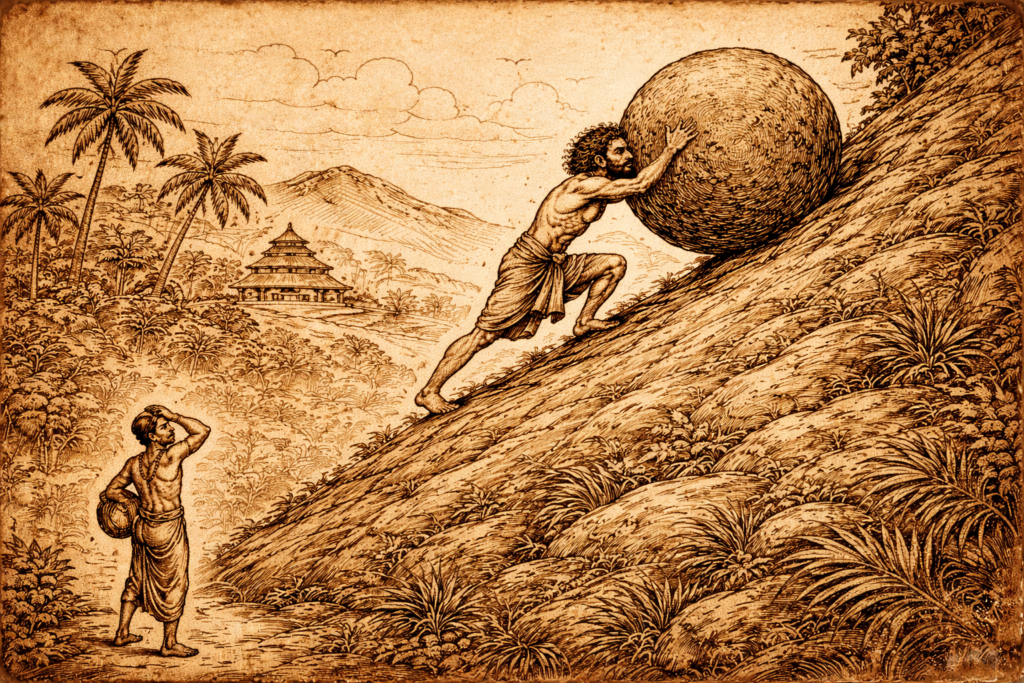
He walked to Rayiranellur hill, near Thiruvegappura, where a large boulder sat at the base of a modest slope. And he began.
Part Two: The Practice
The first time he pushed the boulder, there was no audience. He arrived at the base of the hill in the early morning, when the light was still flat and the dew was on the grass, and he put his hands on the stone and began to push.
He was not a large man — the tradition describes him as lean and weathered, with the build of someone who has spent years walking. But the boulder, which was large, moved under sustained pressure. Slowly, with the particular effort that large stones demand — the kind of effort that requires the whole body, that makes the back speak and the hands bleed, that cannot be maintained through technique alone but only through something more fundamental than technique — it moved.
He pushed it to the top. It took most of the morning.
At the summit, he stood beside the boulder and looked out over the valley. The paddy fields below were green in the light. A heron was standing in the shallows of a distant pond, absolutely still. The Western Ghats rose in the distance, blue and enormous and entirely indifferent to the small drama unfolding on the small hill.
Bhranthan stepped back and let the boulder go.
It rolled. Slowly at first — the first rotation, the gathering of momentum — then faster, the physics of descent asserting themselves with the certainty of everything inevitable, bouncing once off a rock outcropping, raising a small cloud of dust, and finally coming to rest at the exact point where it had started.
Bhranthan watched it all the way down.
And then he laughed.
Not the laughter of surprise, not the nervous laughter of someone filling silence. A deep, full-bodied laugh, coming from a place so far below the surface of the personality that it bypassed everything — the scholarship, the social position, the accumulated dignity of a man who had studied at a respected institution and was expected to behave accordingly. It came from somewhere the texts had not reached. It came from somewhere that the texts were about, without knowing it.
The handful of people who witnessed this looked at each other. Then they looked at Bhranthan, who was already beginning to walk back down the hill.
He came back the next morning. And the morning after that.
Part Three: The Question He Was Answering
The villagers went through the predictable stages. First curiosity — what is this man doing? Then amusement — it is funny, in a benign way. Then concern — is he dangerous? Should someone speak to him?
Then something more complicated. Because people who spent time watching Bhranthan push his boulder began to notice something that they could not quite articulate but could not ignore: he was not suffering.
This was not supposed to be possible. He was doing something futile — everyone could see that. The boulder went up, the boulder came down, the boulder went up again. Nothing changed. Nothing was built, nothing was produced, nothing was achieved. By every measure available to the world he lived in, which valued production and achievement and the accumulation of merit in various forms, he was wasting his time.
And yet there was something in the quality of his attention — the complete, unhurried, genuinely interested attention he brought to the boulder every single morning, as if it were the first morning and the most important thing in the world — that made it very difficult to feel sorry for him. He was not to be pitied. He was, somehow, doing exactly what he was supposed to be doing. Even the people who thought he was mad could feel this. It made them uncomfortable in the way that certainty you cannot refute always makes people uncomfortable.
A merchant from the town, passing through one afternoon, stopped to watch. He was a successful man — warehouses, trade routes, a family, the respect of his peers. He watched Bhranthan push the boulder to the top and then let it go, and then laugh as it rolled back down.
“Why do you do this?” he asked. The question came out more genuinely than he had intended.
Bhranthan turned and looked at him. His eyes, the merchant would later say to anyone who asked, were not the eyes of a madman. They were the eyes of someone who had thought about something very carefully for a very long time and had arrived somewhere most people never reach.
“What is the point of anything you do?” Bhranthan replied. His voice was calm, conversational, as if discussing the weather. “You build your warehouses — they will crumble. You earn your money — you will leave it behind when you die. You raise your children — they will go their own way, and then they will die too. You push your own boulders up your own hills every single day.” He gestured at the rock at the bottom of the hill. “At least I know mine will fall. Do you?”
The merchant opened his mouth. Closed it. Stood there for a long moment.
He continued on his way without speaking. But people who knew him said he was different after that afternoon. Less frantic. More willing to sit with things as they were rather than constantly rearranging them in the hope that the next arrangement would be the one that finally held.
Part Four: Is It Noon Yet?
There was another practice of Bhranthan’s that the tradition preserves with care, alongside the boulder.
On some mornings, after the pushing, he would stand at the top of the hill and look at the sun. He would shade his eyes with his hand and call out — not quietly, not to anyone in particular, but loudly, with the full voice of a man who is asking a real question:
“Is it noon yet? Is the sun at its peak?”
The villagers found this, if anything, more baffling than the boulder. Why was he asking about the position of the sun? He could see where the sun was. He had eyes. The question seemed to contain a confusion that the boulder practice did not.
It took years — in some versions of the story, it took someone asking him directly, and his answer — before the meaning of the question became clear.
He was not asking about the sun. He was asking about the light of knowledge. The sun at its peak is the moment of full illumination — the moment when the light falls without shadow, when there is nowhere for darkness to hide, when everything is visible. He was asking: has this happened yet? Has the knowledge reached its peak? Has the light of genuine understanding — not information, not learning, but the actual illumination that learning is supposed to produce — finally arrived?
The question was addressed to everyone. Every time he called out across the valley: is it noon yet? — he was asking the farmers in their fields, the merchants on the road, the scholars in their study rooms, the priests in their temples. Has the light reached its peak in you? Have you seen clearly yet? Or are you still working in the shadow of half-understanding, mistaking the learning for the thing the learning is about?
Nobody answered him. Which was, in its own way, an answer.
Part Five: The Encounter at the Cremation Ground
Not all of Bhranthan’s stories are about the boulder and the hill. The tradition preserves other episodes — stories of his encounters with people who came to test him, with spirits, with figures of authority both temporal and divine.
One of the most telling is the story of what happened when he was found at a cremation ground.
He was there, sitting as he sometimes sat — in places that other people avoided, with the ease of someone for whom the conventional categories of auspicious and inauspicious have become transparent. The cremation ground at night, which sends most people hurrying in the other direction, was to Bhranthan simply a place, with its own quality of silence and its own particular kind of truth.
Some people came and found him there and were disturbed by it. They were disturbed not because he was dangerous but because he was calm — because he was sitting in a place that was supposed to be fearful with the ease of someone sitting in his own living room, and this calmness was more unsettling than any ghost could have been.
“Are you not afraid?” one of them asked.
Bhranthan looked at them. “Show me a place where I am not,” he said, “and I will go there and be afraid.”
The question underneath this answer is worth sitting with. Show me a place where I am not. It is not merely a clever response. It is the statement of someone who has understood something about the nature of the self that most people spend their entire lives not understanding — that the self is not a bounded thing that can be placed in some locations and not others, that fear arises from the perception of a self that can be threatened, and that a self which is not a bounded thing cannot be threatened in the way that fear requires.
Bhranthan had arrived at this understanding not through meditation in the formal sense, not through the study of Vedanta, not through any of the established routes that the tradition recognized as the paths to this realization. He had arrived at it through the boulder. Through the daily practice of pushing and watching fall and laughing and beginning again. Through the sustained engagement with futility that had, over years, dissolved the part of him that was invested in the outcome.
Part Six: The Light He Left Behind
Bhranthan lived on and near Rayiranellur hill for many years. He was not, in the end, merely the madman that the villagers had first named him. He was what the tradition calls a Mukhta — a liberated being, someone who has dissolved the knot of self-contraction that keeps most people spinning in the cycle of striving and disappointment. The madness was, as the tradition now understands, a performance — the performance that liberated beings sometimes adopt because it is the only available disguise for a state that the conventional world has no category for.
He taught. Not formally — he had no school, no curriculum, no system. He taught the way that genuinely realized people teach: by being what they are in the presence of others, and allowing those others to take from that presence whatever they are ready to receive. The merchant who asked about the boulder. The villagers who watched the pushing. The people who found him at the cremation ground. Each of them received something, calibrated to what they were ready for.
He came, in his later years, to Triprayar temple, where an incident occurred that the tradition preserves with particular care: the altar stone had been moving — not dramatically, but persistently, a movement that the priests could not explain and could not stop. Bhranthan arrived, assessed the situation through what the tradition calls his yogic powers, and instructed the temple tantri to drive a nail into the stone at a specific point, with specific mantras. The movement stopped. The mark where the nail was driven can, the tradition says, be seen in the temple to this day.
He also, in a different incident, spat pan — betel leaf and lime, the chewing material he was rarely without — into the installation slot of a deity that kept falling off its platform, said irikkeda pulayadimone avide — sit there, you son of a Pulaya woman — and the deity was fixed. The slot full of betel spit spilled over, and the nearby water body became known as Taamboolappuzha, which later became Ambalappuzha.
These stories are jarring in their specificity — the betel spit, the profanity, the irreverence toward a deity. They are kept precisely because of this jarring quality, because they say something true about what Bhranthan was. He was not reverent in the way that institutions require reverence. He was something deeper than reverent — he was familiar with the sacred in the way that only people who have fully encountered it can be familiar with it. The Goddess was not above him. She was, in his understanding, him — the same reality, a different appearance.
He was a man who had understood something, and who communicated it in the only language available to him, which was the language of the body — the pushing, the laughing, the question about noon, the sitting in the cremation ground, the betel spit in the idol’s slot. All of it: the same message, delivered in a hundred different forms.
Is it noon yet? Is the sun at its peak?
At the top of Rayiranellur hill, there is now a temple. Thousands of people climb the hill on the first day of the Malayalam month of Thulam, in October, seeking blessings. The stone at the base of the hill is still there.
Nobody pushes it anymore.
They don’t need to. The story is the pushing now.
Naranathu Bhranthan is one of the legendary figures from Aithihyamala, the great collection of Kerala folklore compiled by Kottarathil Sankunni in the early twentieth century. He is believed to have lived approximately fifteen hundred years ago. The Rayiranellur hill temple in Palakkad district is actively worshipped and visited by thousands of pilgrims annually.Naranathu Bhranthan is one of the legendary figures from Aithihyamala, the great collection of Kerala folklore compiled by Kottarathil Sankunni in the early 20th century. The Parayi Petta Panthirukulam — the twelve children of Parayi — remains one of the most celebrated story cycles in Kerala’s cultural heritage.