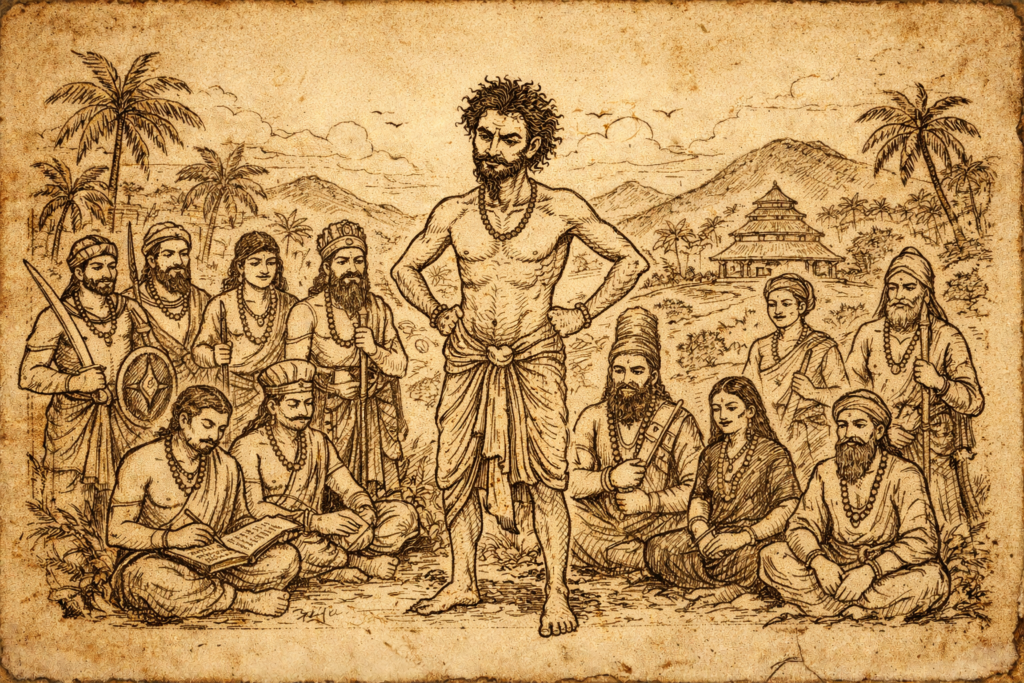
A story of a scholar who chose love over learning, a woman who walked beside him without apology, and twelve children who became the memory of a civilization.
A Note to the Reader
There are stories that belong to a time and a place, and there are stories that belong to everyone. The legend of Parayi Petta Panthirukulam — the twelve children born of the scholar Vararuchi and his wife Panchami, a woman of the lowest caste — is both.
It belongs to Kerala. It was born in the green, rain-soaked landscape of that small southwestern state, in the tangle of its backwater channels and its coconut groves and its ancient temples and its complex, layered social world. The characters move through a Kerala that existed perhaps fifteen hundred years ago, in the time of kings and scholars and a caste hierarchy so rigid that the space Vararuchi and Panchami occupied together was, by every social logic available to them, impossible.
And it belongs to everyone, because what it is about — the courage to choose love over position, the willingness to walk an uncertain road, the question of what a parent owes a child and what a child carries forward from parents they never knew — these things have no geography.
The story has been told many times. The version preserved in Aithihyamala — the great collection of Kerala folklore compiled by Kottarathil Sankunni in the early twentieth century — is the most complete and the most authoritative. This retelling draws from that source, and from the oral traditions that surround it, with the aim of giving the story the space it deserves: not a summary, not a myth reduced to its bare facts, but a full account of what happened and why it matters.
The mother’s name was Panchami. She was a woman of the Parayi community — a caste defined by the work its members did, positioned at the very bottom of the social hierarchy of its era. The story cycle is called Parayi Petta Panthirukulam — “the twelve clans born of the Parayi woman” — not because Parayi was her name, but because her caste was the fact that made everything that followed remarkable.
Her name was Panchami. And she was, as you will see, the strongest person in this story.
PART ONE: THE SCHOLAR
Chapter 1: The Court of Vikramaditya
In the city of Ujjain, in the court of King Vikramaditya, there was a tradition that the king maintained with the particular stubbornness of a man who understands that the quality of the minds around him determines the quality of his own thinking. He gathered the best scholars of his age. He called them his Navaratnas — his nine jewels. And he tested them, constantly, with the questions that had no easy answers.
Vararuchi was the jewel among jewels.
He was a scholar of Sanskrit grammar and logic, a commentator on Panini, a man who had spent so many years in the company of the canonical texts that he moved through them the way a skilled river pilot moves through familiar waters — with the ease of deep familiarity and the confidence of someone who has navigated every current and knows where every rock lies. He had been tested by every scholar the court had produced. He had not been found wanting.
He was also, though he would not have used this word for it, restless.
Not with his position. Not with his scholarship. The restlessness was more fundamental than that — a persistent sense that the architecture of his life, however impressive its facade, was built on a foundation that did not go all the way down. That the questions his learning could answer were not quite the questions that mattered. That the frequency he was tuned to — the frequency of scholarship, of debate, of the careful elaboration of knowledge — was producing, with great precision and great effort, the wrong signal.
He did not know what the right signal was. He only knew he had not heard it.
Then the king asked a question.
It was not an unusual question for Vikramaditya’s court — the king had a gift for questions that appeared simple and revealed themselves, under examination, to be bottomless. He asked: what is the most important verse in the Ramayana? And within that verse, what is the most important phrase?
The scholars of the court offered their answers. Vararuchi offered his. None of them satisfied the king.
This was not the problem. The king’s dissatisfaction was a familiar condition of court life, to be weathered and resolved. The problem was what followed.
Vararuchi’s rivals — and a man of his standing accumulates rivals the way a ship accumulates barnacles, through the simple fact of moving through a medium where others also move — seized the moment. They convinced the king that Vararuchi, uniquely, should be able to answer this question, and that his failure to do so was not merely intellectual but a matter of honor. The king, in a moment of judgment that he would perhaps later revisit, agreed. He gave Vararuchi forty-one days to return with the correct answer. If he could not find it, he need not return at all.
Vararuchi left the court.
He traveled. He went to scholars he had not previously consulted, asking his question, receiving answers that did not satisfy him. He went to temples. He went to forests where ascetics lived, people who had given up the world of courts and scholarship for the world of direct practice, and he asked them too.
On the fortieth night — one day before his deadline — he was resting under a banyan tree at the side of the road when he heard voices above him. Not human voices. The voices of spirits — Kaalameni birds, in the tradition’s telling, spirits who had come to visit others of their kind who resided in the tree’s branches.
And in their conversation, he heard the answer.
The most important verse was the advice given by Sumithra to her son Lakshmana, when Rama, Sita, and Lakshmana were setting out for their years of forest exile. The verse said: consider Rama as your father, consider Sita as your mother, consider the forest as Ayodhya. Go happily, my son.
And the most important phrase within it: Maam vidhi Janakaatmajam. Consider Sita as your mother.
Vararuchi understood immediately why this was the answer. It was not a verse about heroism or duty or the great cosmic drama of Rama’s story. It was a verse about how to be present to what is actually in front of you — how to make a home in the place you find yourself, with the people you find yourself with, rather than in the place you have left or the place you are trying to reach.
He also heard something else.
The spirits, in their conversation, let slip a piece of information that was not meant for human ears: Vararuchi, the great Brahmin scholar, was destined to marry a girl just born in a Paraya family.
Chapter 2: The River and the Raft
Vararuchi returned to the court. He gave the king the answer — the verse, the phrase, the explanation — and the king was pleased. The crisis was resolved. The rivals were frustrated.
But Vararuchi could not un-hear what he had heard under the banyan tree.
He was a Brahmin. A scholar of the highest standing. Marriage to a woman of the Paraya community was not merely unconventional — it was, in the cosmology of his world, a violation of the order that held everything together. He understood this order. He had spent his life operating within it. And he could not accept that his fate had been decreed in this direction.
He used his position at court to find the child. She had been born in a nearby village, in a Paraya household. He convinced the king — through what logic the accounts do not say clearly, though they suggest it involved exaggerated claims about the danger the child represented to the kingdom — that the child needed to be dealt with.
The girl was placed on a small raft made of banana plant stalks, with a lit torch fixed to it, and set adrift on the river.
Here the story pauses. The infant on the raft, the river at night, the torch burning. A girl who has been in the world for perhaps a few days, already the subject of a powerful man’s fear.
She floated downstream.
She was found.
A woman of a Namboothiri family — one of the great Brahmin households of the region — saw the raft and retrieved the child. She raised her. The girl grew up in a Brahmin household, educated in the ways of that world, unaware of her origins.
She was raised as Panchami. Because she was the fifth child of her adoptive family, or because five carries auspicious meaning in the tradition, or because the name simply suited her — the accounts vary on this. What they agree on is the name. Panchami.
And fate, which had been set in motion the night under the banyan tree, continued on its course.
Chapter 3: The Meeting
Years passed. Vararuchi traveled. He was no longer the restless scholar circling his own insufficiency — he was a restless man, carrying the weight of what he had done to an infant on a river, carrying the knowledge that he had tried to refuse his destiny and that the universe, in his experience, did not negotiate with refusals.
He came one day, during his travels, to a Brahmin household near the Nila river. He was hungry. He asked for food.
There was a particular tradition of hospitality that governed these situations — a scholar arriving at a household had certain expectations, and a household with certain resources had certain obligations. But Vararuchi, being Vararuchi, did not simply ask for food. He set conditions. Coded conditions — expressed in the formal Sanskrit that only someone of considerable learning could both offer and interpret.
He said: I will eat here only if the food is prepared without fire touching water, only if the serving vessel is made of a material that is neither clay nor metal nor wood, only if the one who serves me has never been touched by the sun.
These conditions were, on their surface, impossible. They were a scholar’s test — the kind of thing that a man of Vararuchi’s training offered not because he expected them to be met but because the attempt to meet them would tell him something about the household.
From inside the house, a girl’s voice answered.
She said: the conditions will be met.
And they were. The food was prepared in a way that satisfied the first condition. The vessel was made in a way that satisfied the second. The girl who brought the food had lived in such a way that satisfied the third.
Vararuchi looked at the girl who served him.
He recognized her. Not with his eyes — he had never seen her. But with something older and deeper than eyes. The recognition of a man who has spent years moving toward something he could not name, and has arrived.
He knew.
This was the child from the river. This was the woman his destiny had pointed toward. This was Panchami.
He asked to marry her. The household agreed. They were married.
And then, as the tradition records, Vararuchi came to understand the full weight of what his fear had set in motion years before. The woman he had tried to destroy on a river was the woman his life had been moving toward. Fate had not been refused. It had simply taken a more complicated path.
He excommunicated himself from the Brahmin community. He announced it formally, as the tradition required — that he had married outside his caste, that he accepted the consequences, that he would no longer claim the standing that his birth and scholarship had given him.
Then he and Panchami began to walk.
PART TWO: THE WOMAN
Chapter 4: Panchami
Before we follow Vararuchi and Panchami onto the roads of Kerala, we should spend a moment with the woman herself. Because the tradition — which is, like most traditions, more comfortable with the scholar than with the Paraya woman — tends to give her less space than she deserves.
She was found on a river as an infant. She was raised by a Brahmin family, which means she received an education that was better than what most women of any caste in her era received. She learned to read. She learned the domestic arts of the household she grew up in. She learned, from the women around her, how to manage the complex social world of a high-caste Kerala household — the rituals, the protocols, the careful navigation of a world in which everything had its proper place.
And she developed, in the process of growing up in a world that was not quite hers — not the world she had been born into, not the world her caste assigned her to — a particular quality of attention. The attention of someone who has always been slightly outside the frame, looking in with clear eyes, seeing what others who are inside the frame cannot see because they are too close to it.
She saw Vararuchi when he arrived at the household and offered his impossible conditions. She did not see a famous scholar. She saw a man who was testing something — she was not sure what — and she understood, with the directness that was her defining quality, that the right response to the test was to simply meet it.
She met it.
She served him his meal.
When he proposed marriage, she agreed. Not out of desperation — she was not in a desperate position, raised in a respectable household with prospects appropriate to that household. Out of the same directness. She saw him clearly. She agreed.
What she thought when she learned the truth — about the river, about the raft, about the torch burning in the dark — the tradition does not tell us. It preserves her silence on this subject with a completeness that might be respect or might be the old habit of not asking women about their interior lives.
What the tradition does tell us is what she did next. She walked. Beside her husband, on the roads of Kerala, through the monsoons and the summers and the cool months, through villages that welcomed them and villages that turned them away, through everything that followed.
She walked.
Chapter 5: The Road
The roads of ancient Kerala were the roads of a landscape still largely untamed — dense forests between the settled areas, backwater channels that changed course with the floods, paths that were reliable in the dry months and vanished in the rains. Walking these roads was not leisure. It was work, sustained over months and years, requiring the kind of physical endurance and psychological stability that we do not often associate with scholarly households.
Vararuchi and Panchami walked them.
They were, in the social terms of their world, impossible together. The Brahmin scholar who had excommunicated himself and the Paraya woman he had married walked side by side, and everything about this was wrong by the standards of everyone they encountered. The wrong caste. The wrong combination. The wrong kind of dignity — not the dignity of position or wealth or lineage, but the quiet, self-contained dignity of two people who have chosen each other fully and are not interested in anyone else’s opinion of that choice.
They were received, often, better than they might have expected. There is something about genuine dignity — the kind that asks nothing and defends nothing — that people respond to, even across the boundaries they are supposed to maintain. Households that should have turned them away gave them food. Temples that should have excluded them allowed them to pray. The world, in the specific moments of their journey, was kinder than the rules said it should be.
And they were received, sometimes, exactly as the rules predicted. Turned away. Diminished. Reminded of what they were and were not.
They continued walking.
PART THREE: THE TWELVE BIRTHS
Chapter 6: The Question
Panchami became pregnant.
The first pregnancy, the tradition says, found them on the road north of the Nila river, in the forest country that stretched between the settled areas. When the time came, Vararuchi sent Panchami into the denser part of the forest — away from the path, where she would have privacy and some shelter from the elements.
She delivered the child alone, in the way that women in her community had always delivered children — without the elaborate ritual attendance that Brahmin births received, with the knowledge passed between women across generations, with the particular competence of someone doing something difficult that she had prepared for and understood.
When it was done, she came back to where Vararuchi waited on the path.
He asked her: does the child have a mouth?
This question requires explanation, because it is the center of everything that follows, and it is easy to misread.
Vararuchi was not asking out of cruelty. He was asking out of a worldview — a specific, deeply held understanding of fate and divine provision that was not unusual in his tradition. The idea was this: a child who enters the world with a mouth has been given, by God, the instrument of survival. God will feed what God has equipped to be fed. The child will find its way. The parents’ task is to release it into the world’s care and trust that the care will come.
This is not, by any standard we would apply today, an adequate philosophy of parenting. But it was not random cruelty either. It was the theology of a man who believed, with the conviction of someone who has studied the texts long enough to feel their logic in his bones, that divine provision is real and that the attempt to control what God has already arranged is not wisdom but interference.
Panchami understood this. She had been told before the journey began what the arrangement would be.
She said: yes. The child has a mouth.
Vararuchi said: God will feed the one with a mouth. Leave the child here.
Panchami left her firstborn child in the forest near Vemanjeri Mana, in the Thrithala region of what is now Palakkad district. A Namboothiri family from that household found the child and raised him. He grew up to become Mezhathol Agnihothri — the fire-keeper, the eldest of the twelve, the one at whose house the others would gather every year for the rituals of their parents’ death.
And Vararuchi and Panchami walked on.
Chapter 7: The Second Child, the Third, the Fourth
The second child was born further along the road, in a different forest clearing, with the same question and the same answer and the same leave-taking. This child was found by a Paraya family in Thrithala’s Eerattinkal colony, and grew up to become Pakkanar — the wandering scholar-magician, the second of the twelve, the one who learned wisdom from baskets.
The third child was found by a Syrian Christian family near Kottayam. He grew up to become Kadamattathu Kathanar — the priest who walked between the worlds of faith and the occult, who bound the Yakshi Kalliyankattu Neeli to her tree.
The fourth child was found by a family near Naranam in Kottayam. He grew up to become Naranathu Bhranthan — the philosopher of the boulder, the madman of the hill, the one who laughed at the falling and found, in the laughter, something that none of his brothers’ more conventional practices had produced.
Each time: the forest clearing. The question. The answer. The leaving.
Each time, Panchami said yes. The child has a mouth. And each time, she left her child behind and walked on.
We should pause here and feel the weight of this. Not as abstraction. As the specific, physical, irreducible experience of a woman who has just given birth — whose body is doing what bodies do in the hours after birth, whose every instinct is oriented toward the infant she has just brought into the world — and who picks up that infant and places it where it can be found and then walks away.
Eleven times.
Panchami did this eleven times.
The tradition preserves this fact without much commentary, in the way that it preserves many of the facts about Panchami — noting them, giving them their place in the structure of the story, and moving on to the next event. This is a failure of imagination that we can try to correct. What she did, eleven times, was not merely follow her husband’s theology. It was an act of sustained courage of a kind that has no equivalent in most of our experience. She gave away eleven children. She believed — she had to believe, or she could not have continued — that each of them would be found, would be cared for, would become what they were going to become. And she walked on.
Chapter 8: The Children and Their Families
Between the second child and the twelfth, the tradition gives us the following:
Pakkanar — found by a Paraya family in Thrithala. Grew up making baskets, learning in the making of baskets the things that scholarship could not teach. Became the wisest of the twelve in some traditions — the one whose wisdom had no vanity in it, who could see through the pretensions of the learned, who is credited with extraordinary feats of knowledge and occasionally of magic. He is the one who, in the annual gatherings at Agnihothri’s house, is received with the most complicated feelings — both revered and uncomfortable, because his clarity cuts through the social hierarchies that everyone else is trying to maintain.
Kadamattathu Kathanar — found by a Syrian Christian family near Kottayam. His story has been told in full in this collection. He is remembered as the one who protected — who walked between the worlds of faith and power without being consumed by either.
Naranathu Bhranthan — found by a family near Naranam. His story too has been told. He is remembered as the one who understood — who looked at the question of existence long enough and directly enough to find, if not an answer, then at least a practice that made the question livable.
Perumthachan — found by a carpenter family in Uliyannoor, raised by a craftsman named Raman. He became the greatest architect and carpenter in Kerala’s tradition — a man whose understanding of wood and structure was so profound that the temples and palaces he built are still standing. He is remembered as the one who made things that lasted. There is a darker story about him too — a story about a student who threatened to surpass the master, and what the master did to prevent this — that the tradition preserves with the discomfort of something true that is also uncomfortable.
Rajakan — found by a washerman’s family. He grew up doing the work of the lowest caste and developing, in that work, a quality of service that was indistinguishable from devotion. He became a warrior-saint — a fighter whose fighting was understood as prayer. He is remembered in the Tantric traditions as a Siddha, a realized being.
Vallon — found by a Nair warrior family near Thrithala, abandoned along the Nila river. He grew up in the martial tradition of the Nair community and represents its values in the Panthirukulam story. The details of his life are less preserved than some of his brothers.
Vaduthala Nair — found by the Kundooly Nair family. Like Vallon, he represents the martial Nair tradition. The tradition is clearer about his family than about his individual story.
Uppukottan — found by a Muslim family in Ponnani, raised in that faith. He became a trader, dealing in salt and cotton — known for the particular eccentricity of his trading habits, transporting salt to Palakkad and cotton back, doing business in the way of someone who has understood that the value of a thing is entirely dependent on where you are standing. He is the Muslim among the twelve — the tradition’s acknowledgment that Islam had been part of Kerala’s social fabric long enough to be included in the founding family of the civilization.
Paananaar — found in Thiruvarangu by a Panan family, a community of musicians. He became a master of the udukku — a small drum — and his music is described in the tradition as something that went past technique into the territory of the sacred. He played, it is said, before Lord Shiva himself.
Karakkal Matha — the only woman among the twelve. Found by the Kavalappara Palace near Shornur, in Palakkad district, where women were given special consideration. She became a figure of devotion — a saint in the South Indian tradition, associated with miraculous events and profound spiritual attainment. The tradition preserves her with particular care, perhaps because her presence among the twelve complicates the story in interesting ways: the only daughter, the only one who achieved recognition in the specifically religious sphere of female sanctity.
Rajakan, Vallon, Vaduthala Nair, and Uppukottan — of these four, the tradition is least detailed. The families where some were raised are unknown. The specific shape of their lives and what they became is preserved only partially. This is not unusual — the oral tradition keeps what communities find useful and lets go of what they don’t, and these four, for whatever reason, were preserved less completely than their brothers.
Chapter 9: The Twelfth Birth
Eleven children had been born. Eleven times, Panchami had come back to the path with the answer Vararuchi needed to hear, and eleven times she had left her child behind.
The twelfth pregnancy came toward the end of the pilgrimage — when they were older, when the roads had done their work on their bodies, when the years of walking had settled into them as a way of being rather than a journey with a destination.
The twelfth child was born. Panchami went into the forest. She delivered the child. She came back to the path.
And this time, when Vararuchi asked — does the child have a mouth? — she lied.
She said: no. The child has no mouth.
She had given eleven children to the world. She could not give a twelfth. Whatever theology she had accepted at the beginning of the journey, whatever understanding of divine provision and fate she had walked eleven births believing in — at the twelfth, something in her refused. She wanted to keep this one. She needed to keep this one.
She said the child had no mouth.
Vararuchi looked at her. He knew, or he suspected, or he simply accepted her word — the accounts differ on what was in his face at that moment. He said: very well. We will keep this child.
And then Panchami looked at the child she was holding.
The child had no mouth.
In the moment of her lie, the thing she had lied about had become true. The child she had tried to save by claiming he had no mouth had been transformed, in the instant of the claim, into a child without a mouth. Whether this is understood as miracle or metaphor or the particular logic of a tradition that takes seriously the creative power of speech — the tradition simply records what happened: she said it, and it became true.
Vararuchi took the child to the nearest hillock and consecrated him there — placed him on the hill as a deity, a god without a mouth, to be worshipped. The temple that stands there today is called Vayillakkunnilappan — the lord of the hillock without a mouth. People worship there still.
And Panchami stood at the bottom of the hill and watched her twelfth child become a god.
What she felt, the tradition does not say. We are left to imagine it ourselves — the particular quality of grief that comes from an outcome you brought about through an act of love, the understanding that the lie was not a lie in the way that lies usually work, that something stranger and more consequential had happened in the forest clearing where she held her infant and chose to keep him and lost him anyway.
PART FOUR: THE CHILDREN GROW
Chapter 10: Scattered Across Kerala
The twelve children of Panchami grew up in twelve different corners of Kerala, in twelve different families, in twelve different worlds.
They did not know each other. They did not know, most of them, that they were connected. They grew up with the names their adoptive families gave them, in the traditions of their adoptive communities, learning the crafts and the knowledge and the worldview of whoever had raised them.
But they knew — all of them, as they came into their full powers — that they were different from the families that had raised them. Not in a way that anyone could point to and name, but in the way that people who carry something exceptional in them always know it: through the quality of their attention, the depth of their curiosity, the sense that the questions they are asking are larger than the questions the world around them is equipped to answer.
They began, separately, to seek.
Agnihothri sought in the Vedic fire traditions. Pakkanar sought in the forest, in the practice of craft, in the conversations that a man has with himself over years of solitary work. Kathanar sought in the faith he had been raised in and in the occult knowledge that Kerala’s landscape pressed upon anyone who paid attention to it. Bhranthan sought on his hill, with his boulder, through the practice of pushing and laughing and pushing again.
Each of them found something. Not the same thing — twelve different things, in twelve different contexts, with twelve different qualities. But all of them found what they were looking for, in the way that people find things when they have been given, at birth, the capacity to look.
And each of them, when they came into their full powers — usually in their young adulthood, when the adoptive life they had been living had given them everything it was going to give — learned the truth.
The tradition varies on how this happened. Some accounts say they were told. Some say they simply knew, the way certain things are known below the level of information. Some say they encountered each other on the roads of Kerala and recognized something in each other that pointed toward the same source.
However it happened, the truth arrived: they were the children of Vararuchi and Panchami. They were the Parayi Petta Panthirukulam. They were twelve.
And there was a custom — established by who exactly the tradition does not say, but maintained by all of them — that they would gather, once a year, at the house of their eldest brother Mezhathol Agnihothri, to perform the annual death rituals for their parents.
PART FIVE: THE ANNUAL GATHERING
Chapter 11: At Agnihothri’s House
The gathering happened every year. All twelve — or rather, all eleven who could gather, since Vayillakkunnilappan was now a deity on his hill and attended in a different sense — came to Agnihothri’s house for the shraddha ceremony, the ritual offerings for the departed.
This gathering was, in every social sense, impossible. A Brahmin, a Paraya, a Christian priest, a wandering philosopher, a master carpenter, a washerwoman’s son, a Muslim trader, a musician, a female saint, a warrior — they gathered in the same house, performed the same rituals, acknowledged the same parents.
The tradition does not present this as easy. Agnihothri’s wife — a woman of the Brahmin household, for whom the caste rules were not abstractions but the structure of daily life — did not welcome these gatherings. She found them deeply uncomfortable. Her home was being used for rituals that, by any conventional understanding of the rules she had been raised with, should not happen there.
She complained. Not publicly, not directly — that was not how complaints were managed in that social world — but Agnihothri knew.
One year, he decided to show her something.
He asked her to come with him. To visit each of his brothers, in their rooms, during the night before the ceremony. To simply look.
She agreed, perhaps because she had no reason to refuse, perhaps because she wanted her discomfort acknowledged even if she could not articulate it directly.
They went to the first room. Pakkanar was sleeping. Agnihothri’s wife looked at him and saw — not a Paraya man, not someone of low caste, not the social category she had been trained to see when she looked at someone of his community. She saw what was actually there, in the way that vision sometimes works when the frame is removed: a man at rest, carrying in his sleeping face something that she had no category for but that she recognized, in the wordless way of genuine recognition, as something close to sacred.
They went to the second room. Kathanar was sleeping. The same thing.
They went to each room, each brother, each of the eleven. And in each of them, Agnihothri’s wife saw the same thing — not the social category, not the caste, not the approved or disapproved position in the hierarchy. She saw what was there. She saw Mahavishnu’s posture, the Gadapadma resting, in each of her husband’s brothers as they slept.
She came back to their room changed. Not cured of her social conditioning — that is not how social conditioning works, and the tradition is honest enough not to claim it. But changed. Cracked open, in the specific place where certainty lives.
She never complained about the gatherings again.
Chapter 12: What Bhranthan Saw
Naranathu Bhranthan attended these gatherings in his own way. The boulder years had given him a quality of presence that made ordinary social situations feel, to the people around him, slightly unusual — as if the room itself had become more honest than it usually was.
He walked to Agnihothri’s house the year of the episode with the wife. He arrived before the others — his wandering pace was unpredictable, and he sometimes arrived at places before anyone expected him and sometimes long after.
He sat in the courtyard and watched the preparations for the ceremony. The Brahmin rituals, the fire, the precise movements of a tradition that had been maintained for centuries with the care of something that must not be allowed to change. Agnihothri moving through it with the authority of a man who has done this so many times that his body knows the sequence before his mind does.
And alongside it: Pakkanar watching from a corner, with the particular quality of attention that a man develops when he has spent years making baskets — the attention that sees structure in everything, that finds in the ritual the same logic as in the weaving. Kathanar sitting with his cross and his private knowledge of what lies beneath the surface of the visible world. The others, each bringing to the same ritual the different quality of whatever practice had shaped them.
Bhranthan watched all of this and felt, for perhaps the first time in his life, something that was not the question and not the laughter and not the quiet that the Goddess had given him on the hill.
He felt gratitude.
Not the gratitude of someone who has received something they wanted. The gratitude of someone who has looked at something and understood, fully, how extraordinary it is that it exists at all.
Eleven brothers, sitting in the same house, performing the same ritual for the same parents, carrying between them the entire social spectrum of Kerala — every caste, every community, every tradition — and connected, underneath all of that, by the same blood and the same story and the same beginning, which was a woman in a forest clearing saying yes, the child has a mouth, and leaving her baby behind and walking on.
Panchami had done this eleven times. And the result was sitting here, in this courtyard, in all its improbable diversity, doing what families do: gathering, remembering, being together.
Bhranthan looked at his brothers. He thought about his mother — the woman he had never known, who had never known him, who had held him for whatever brief time she held him before placing him in the world and continuing her walk.
She was, he thought. She was the center of this. Not Vararuchi, with his scholarship and his destiny and his complicated theology of divine provision. Panchami. Who had walked every road. Who had given every child. Who had lied, once, to keep one, and lost him to the hill. Who had walked on.
She was the stronger one.
PART SIX: BHRANTHAN’S JOURNEY
Chapter 13: Walking the Roads His Parents Walked
There came a year — Bhranthan was old by then, the boulder years settled into him like a second skeleton — when he decided to walk the roads his parents had walked. Not as pilgrimage. Not as search. Simply as an act of understanding: to see the places where his brothers had been left, to meet the brothers he had not yet met, to walk the landscape that had absorbed his parents’ journey and given back twelve children.
He started in the north and moved south, which was the direction of the Nila river and the communities that had grown up along it.
Chapter 14: Pakkanar
He found Pakkanar in a forest clearing near Thrithala, weaving a basket. Not a man weaving a basket while thinking about something else — a man giving a basket his full attention, the way that only people who have understood what attention is for can give it.
Bhranthan sat nearby and said nothing. He waited.
Pakkanar finished the basket. He set it aside. He looked at Bhranthan.
“You are my brother,” he said. Not a question.
“Yes,” said Bhranthan.
They sat in the comfortable silence of two people who have both spent enough time alone to know that silence is not the absence of communication.
“You push a boulder,” Pakkanar said.
“I used to,” Bhranthan said. “Now I mostly walk.”
“What did you learn? From the pushing?”
Bhranthan thought about this with the care he gave to all genuine questions.
“That the falling is not the problem,” he said. “The problem is expecting it not to fall.”
Pakkanar nodded slowly. “I learned the same thing from baskets,” he said. “You weave them as carefully as you can. They wear out. The weaving is the point.”
They stayed together for three days. In those three days, they talked the way two people talk who have both thought deeply about the same things and arrived at similar places by very different roads — not debate, but recognition. Two different instruments finding the same resonance.
On the fourth morning, Bhranthan continued south.
Chapter 15: Kathanar
He found Kadamattathu Kathanar at his church near Kottayam, saying the morning prayers. The prayers had the quality that Bhranthan associated with genuine practice — not performance, not routine, but the full attention of someone doing something that requires their whole self.
Kathanar saw him coming and stopped. He looked at Bhranthan for a long moment.
“Our father’s son,” he said.
“And our mother’s,” Bhranthan said.
They sat in the church courtyard. Kathanar brought simple food. They ate. They talked.
Bhranthan asked about the Yakshi. Kathanar told him — not the dramatic version, but the direct account. The smell of Pala flowers. The quality of the darkness. The specific technique of the binding.
“You bound her because she was causing harm,” Bhranthan said. “But do you think she knew she was causing harm?”
Kathanar was quiet for a long time. This was not a question he had been asked before.
“I don’t know,” he said finally. “I think she was doing what she was made to do. Whether that constitutes knowing—” he paused — “I am not sure the question has an answer.”
“Most of the important questions don’t,” Bhranthan said. “That’s what makes them important.”
They stayed together for two days. When Bhranthan left, Kathanar stood in the doorway and watched him go — the old philosopher walking down the road with the unhurried pace of a man who has nowhere to be and everywhere to go.
Kathanar, who was not easily moved, was moved.
Chapter 16: Perumthachan
He found Perumthachan in the middle of a construction project — a large temple being built in the northern Kerala style, the woodwork intricate and demanding, the master carpenter moving through the site with the authority of someone who carries the entire structure in his mind.
Perumthachan was a man of few words. His communication happened through what he made.
He saw Bhranthan approaching. He stopped. He looked.
“Brother,” he said.
“Brother,” said Bhranthan.
They stood together and looked at the temple under construction. The woodwork was extraordinary — even to an untrained eye, the quality was evident. The joints. The precision. The sense that the structure was understood, every element in a necessary relationship with every other.
“It will last?” Bhranthan asked.
“A few hundred years,” Perumthachan said. Assessing, not boasting.
“And then?”
“And then it will fall.”
Bhranthan smiled. “Yes,” he said. “Everything does.”
Something in Perumthachan’s face shifted — a slight relaxation, as if a question he had been carrying had been, not answered, but acknowledged in the right way.
“Our father understood this,” Perumthachan said. “He built something. Left it. Walked away.”
“He built twelve things,” Bhranthan said. “And walked away from all of them.”
“And our mother walked with him.”
“Yes.”
A pause. They watched the temple.
“She was the stronger one,” Perumthachan said finally.
Bhranthan looked at his brother. In all the years of thinking about his parents — the scholar he had never met, the woman who had placed him in the world and continued — he had never heard anyone else say this.
“Yes,” he said. “She was.”
Chapter 17: The Others
Bhranthan visited several more of his brothers in the months of his journey.
He heard Paananaar’s drumming from a distance before he saw the man — and in the hearing, understood something about rhythm and presence that the boulder had also taught him but in a different language. He spent an afternoon with Paananaar, the two of them communicating mostly through the rhythms Paananaar tapped on his drum and the quality of silence Bhranthan offered in return.
He sat with Veluthatt the barber and talked about kings — about power and how it works and why people with intelligence so often confuse the possession of power with wisdom. Veluthatt, who had spent a career being trusted with sharp instruments near the faces of powerful men, had thoughts on this subject that were specific and well-founded.
He walked to the edge of the sea with Uppukottan and watched the dawn light move on the water — the particular quality of that light, which Uppukottan had been watching his whole life and could describe in forty different ways depending on the season and the wind and the state of the tide. Bhranthan stood beside his Muslim brother and watched the sea and found in the watching something that confirmed, without words, what the boulder years had been about.
He sat with Karakkal Matha — the only woman among the twelve, his sister — in the courtyard of the palace where she lived. She was a figure of considerable sanctity by then, surrounded by the particular atmosphere that accumulates around people who have done what she had done. They did not talk much. They sat together. Bhranthan found this, in some ways, the most restful of all the visits — the particular rest of being with someone who has also found what they were looking for, and who therefore requires nothing from the encounter.
PART SEVEN: WHAT THEY LEFT BEHIND
Chapter 18: Panchami’s Legacy
Panchami died on the road. This is consistent across all the accounts, though the specifics vary. She and Vararuchi continued walking after the twelfth birth, after the hill, after the consecration of Vayillakkunnilappan. They walked until they could not walk anymore.
What she died thinking, the tradition does not say.
What she left behind is the whole story. Not Vararuchi, though he contributed his half. Not the twelve children, though they became the memory of a civilization. Panchami. The woman who walked every road, gave every child, lied once, and lost the twelfth one anyway. The woman who, in eleven acts of leaving her children behind, trusted the world with what she most valued and kept walking.
This is the hardest kind of courage — not the courage of the sword or the wrestling ring or the contest of wits, which are at least public, which at least produce an audience and a verdict. The courage of the private act, repeated eleven times, witnessed by no one except the forest and the road and God, if God was watching.
Every year, at Agnihothri’s house, the eleven gathered and performed the rituals for her. The Brahmin and the basket-weaver and the Christian priest and the philosopher and the carpenter and the drummer and the Muslim trader and the warrior and the saint — they gathered in the same room and remembered the same woman.
The woman who placed them in the world and walked on.
Chapter 19: The Thread That Holds
What connects the twelve is not obvious from the outside. A fire-keeper, a basket-weaver, a priest, a philosopher, a carpenter, a warrior-saint, a Nair warrior, a another Nair, a Muslim trader, a musician, a female saint, and a mouthless god on a hill — the diversity is total. Every caste, every community, every tradition of Kerala is represented.
But the thread that holds them is this: each of them was given, at birth, the two qualities that their parents carried.
From Vararuchi: the restlessness that refuses to accept insufficient answers. The capacity to keep asking past the point where the question becomes comfortable. The willingness to look at what the texts say and find it, sometimes, not enough.
From Panchami: the clarity that sees what is actually in front of you. The directness that says the true thing without the distortions of ambition or fear. The courage of the private act, the sustained courage, the walking-on.
These two qualities, combined in different proportions in each of the twelve, produced twelve different kinds of wisdom. Not one wisdom expressed twelve times. Twelve genuine wisdoms — each arrived at through a specific practice, in a specific context, with a specific quality of attention that no other context could have produced.
The tradition of Kerala preserved all twelve. Not as curiosities, not as examples of what happens when the caste order breaks down, not as warnings or cautionary tales. As legends. As people worth remembering. As the founding family of something that was true about the civilization — its capacity to hold, within a single story, the entire range of what it was.
Chapter 20: The Laugh at the End
Bhranthan finished his journey and came back to his hill near Thiruvegappura.
He did not push the boulder. He sat beside it in the evening light, with everything the journey had given him — the recognition in Pakkanar’s eyes, the quality of Kathanar’s silence, the way Perumthachan’s face had changed when he said she was the stronger one, the drumming that said things words couldn’t say, the light on the sea at dawn, his sister’s restful company.
He sat and thought about his parents. About the scholar who had followed a frequency south and found Panchami in a paddy field. About the woman who had been set adrift on a river as an infant and had grown up to walk every road in Kerala. About the twelve children they had scattered across the landscape like seeds, each one taking root in the soil it was given and growing into something the world had not quite seen before.
He thought about fate — about the night under the banyan tree when the spirits spoke and Vararuchi heard his destiny and tried to refuse it. About the river and the raft and the torch burning in the dark. About the way that fate had not been refused, had simply taken a longer path, had delivered Vararuchi to Panchami years later in a household where a girl’s voice answered impossible conditions from inside the house.
He thought about the twelfth birth. About Panchami holding her infant and lying — saying the child had no mouth — and the lie becoming true. About the particular quality of that moment, which was not tragedy and was not miracle but was something of both, something that the tradition had preserved because it contained a truth that no simpler story could carry: that the things we try to hold onto sometimes become, in the holding, exactly what we were trying to prevent.
He thought about all of this, with the full attention that the boulder years had taught him — the attention that does not flinch, that does not add or subtract, that simply receives what is there and allows it to be what it is.
And then Naranathu Bhranthan, the philosopher of the boulder, the madman of the hill, the one who had looked at existence long enough to find it funny — laughed.
Not at the absurdity of existence. Not at the futility of striving. Not at the boulder or the hill or the falling.
At the wonder of it. The sheer, improbable, impossible wonder of the fact that any of it had happened at all. That a scholar had heard spirits in a tree and tried to refuse his destiny. That an infant had survived a river on a raft of banana stalks. That eleven children had been placed in eleven corners of a green landscape and had each become something the world would not forget. That twelve people of wildly different lives had sat in the same room every year and offered rice and water to the same departed parents. That his brother had stood beside a temple and said she was the stronger one and had meant it.
That Panchami had walked every road and given every child and lied once and kept walking.
The laugh that comes from the place where gratitude lives.
The rarest kind.
EPILOGUE
The Story and the World
The legend of Parayi Petta Panthirukulam has survived for at least fifteen hundred years. It has been told in houses and temples and toddy shops and rice fields and, in the early twentieth century, set down in the careful, loving prose of Kottarathil Sankunni’s Aithihyamala.
It has survived because it carries something true about Kerala — something that the people of that land have found worth keeping across the generations, even as everything else has changed.
What it carries is this: that the diversity of Kerala — its castes, its communities, its faiths, its traditions — is not accidental, is not merely the result of geography or trade or conquest. It is, in the story’s telling, the result of a choice. A Brahmin scholar chose a Paraya woman. A woman chosen and abandoned on a river chose to give eleven children to the world and keep walking. And from that choice — that impossible, transgressive, world-defying choice — came twelve people who between them represented everything that Kerala was and would become.
The story does not pretend this was easy. Panchami gave away eleven children. Vararuchi excommunicated himself from his community. The twelve brothers and their sister gathered in a house every year where they were not entirely welcome. The world did not rearrange itself around their existence. It simply contained them, as it contains everything — with the indifference that is not hostility but is simply the nature of the world, which goes on being itself regardless of what we do within it.
What the twelve did within it was: become. Each of them, in their specific context, with their specific gifts, became something. And the world was changed by the becoming — not dramatically, not all at once, not in any way that the historians of the era would have recorded. But changed. The way that water changes stone — slowly, continuously, by the sustained pressure of contact.
Panchami never saw any of it. She walked until she could not walk anymore and died on the road without knowing what her children had become.
But she knew what she had done. She had placed them in the world. She had trusted the world with them. She had kept walking.
That was enough. That was everything.
Parayi Petta Panthirukulam — the twelve children born of Vararuchi and Panchami — is one of the great story cycles of Kerala’s cultural heritage, preserved in Aithihyamala, the legendary collection of Kerala folklore compiled by Kottarathil Sankunni in the early twentieth century. The twelve children and their descendants are believed by many families in Palakkad, Thrissur, and Malappuram districts to be their direct ancestors.
The temple of Vayillakkunnilappan — the twelfth child, consecrated by Vararuchi on a hillock in the Palakkad region — stands to this day and is actively worshipped.
The annual gathering of the Panthirukulam families, though much changed from its legendary original, continues in various forms in the communities that trace their ancestry to the twelve.
Panchami’s name is not on any temple. There is no shrine to her, no feast day in her honor, no pilgrimage to her memory. She is in the story, which has lasted fifteen hundred years. Perhaps that is enough.
The Parayi Petta Panthirukulam — the twelve children of Parayi — is one of the great story cycles of Kerala’s cultural heritage, preserved in Aithihyamala, the legendary collection compiled by Kottarathil Sankunni in the early 20th century. The twelve children, their stories, and the story of their parents Vararuchi and Parayi, together form one of the most remarkable family narratives in the folklore of India.