The greatest victories are the ones where the sword stays sheathed.
The morning Aromal Chekavar left for the ankam at Puthariyankam, Unniyarcha was already awake.
She had been awake most of the night. Not from fear — fear was not the thing, or not only the thing. It was the particular alertness of someone who has spent years training their body to read combat, and who cannot, even in the dark of the early morning, stop the mind from doing what training has made it do: assess, calculate, find the weakness in the opponent’s position.
She knew Aringodar. Everyone in the Puthooram house knew Aringodar. He was a Chekavar from Tulunadu, a master of the art, the man that Unnichandror had chosen to represent him in the succession dispute against his brother Unnikonar. Aringodar was the kind of opponent the Puthooram house had never taken lightly, because taking him lightly would be wrong. He was experienced, controlled, and he had been preparing for this duel with the specific preparation of a man who was planning something beyond the fight itself.
Unniyarcha had thought about this. She had thought about little else.
The dispute itself was simple enough by the standards of sixteenth century Malabar — two brothers, Unnichandror and Unnikonar, contesting the succession of their uncle’s estate at Kurungattidem. Neither would yield. Neither could be made to yield. And so they did what that world did with things that could not be resolved any other way: they hired fighters, and the fighters would settle it with their bodies on the ankam ground.
Unnikonar had come to Puthooram Veedu. He had walked up to the house of the Chekavars with twenty-two Nairs at his back and asked for someone to fight his duel. Aromal had agreed. The fee he extracted for the agreement was, by all accounts, substantial — he was the best available, and he knew it, and he made Unnikonar feel the weight of that knowledge in the negotiation. But he agreed. And now the morning had come.
What Unniyarcha knew, that she was not certain her brother fully appreciated, was that Aringodar was not simply preparing to fight. He was already cheating.
She had heard things. The kind of things that travel through the networks of information that women in that world maintained carefully and quietly — the conversations overheard, the details noted, the pattern that emerged when you paid attention to what the men around you thought you were not hearing. Aringodar had been at the ankam ground already. He had been building the wooden angathattu, the fighting platform, under his own supervision. This was not normal. The platform was supposed to be neutral. A fighter who built his own fighting ground was a fighter who was building an advantage into the ground.
She could not prove this. She could not stop the duel. These things, once set in motion in that world, had their own momentum, their own formal structure that required them to conclude in the way they had been set up to conclude.
But she could say something. And there was one person she needed to say it to.
Chandu.
Chandu Chekavar was Aromal’s companion for the duel — his second, the man who would stand beside him on the ankam ground, who would watch for violations of the rules, who was the closest thing to a guarantee Aromal had that the fight would be conducted honestly. He was also the person in this situation who had the most complicated relationship with everyone involved: a cousin who had grown up in the Puthooram house, trained alongside Aromal, loved Unniyarcha and been refused, and was now being asked to stand beside the brother of the woman who had refused him while fighting against his own Guru.
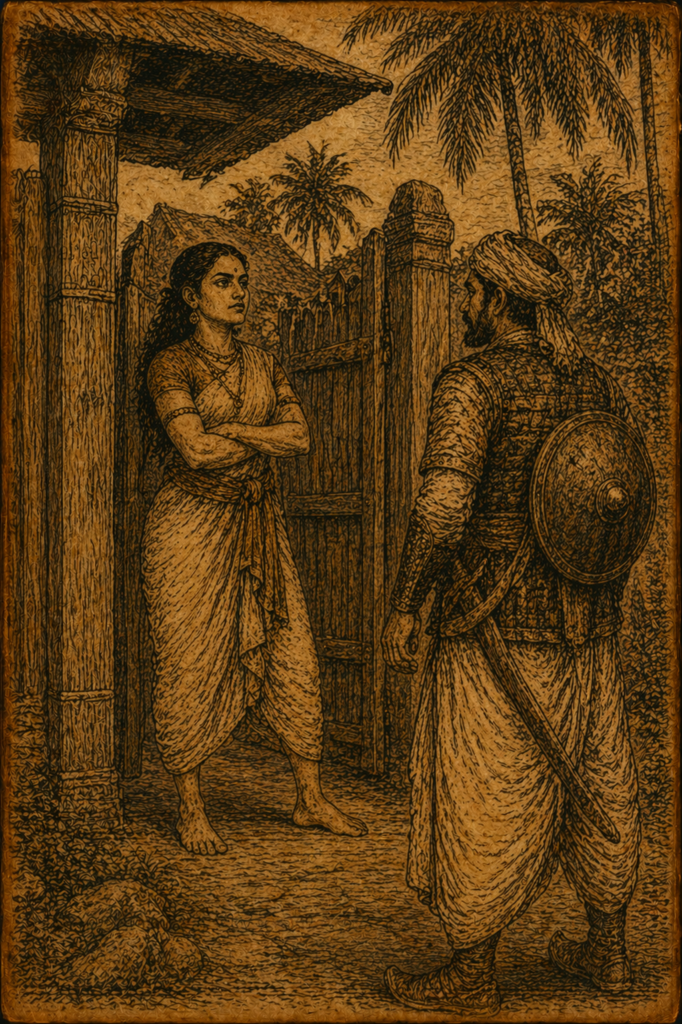
Unniyarcha went to Chandu before he left.
What she said to him, the ballads preserved. Not as background detail — as something worth keeping, word for word, across the centuries:
While my brother is going for the duel,
you are the companion going with him.
When he is on the pedestal for the fight,
do keep vigil and be right beside him.
When the substitute’s churika strikes,
it will hit only through the middle.
If a forged churika is given,
hit through right first —
the substitute’s churika will be thrown off.
She had read Aringodar’s technique from a distance and from memory and from the things she had heard, and she had identified the specific vulnerability in his attack pattern — the way his churika, his sword, came in through the middle on the substitute strike, and the counter that would break it. She was not there as a fighter. She could not stand on the ankam ground. So she put the knowledge in the only place she could put it: in Chandu’s hands, in Chandu’s memory, in the words she spoke to him that morning with the specific precision of someone who has worked out the geometry of a fight they will not be allowed to fight.
Chandu listened. He heard everything she said.
Then he went and made his own arrangements, separately, quietly — arrangements that had nothing to do with the tactical advice she had given him and everything to do with the resentment he had been carrying for years. He went to the blacksmith who had been given Aromal’s swords for preparation and treatment. And he, or someone acting on his behalf, or someone who had their own reasons to want Aromal to lose, ensured that the swords were not right. A wooden nail where there should have been iron. A blade prepared to fail at the moment of greatest stress.
The ankam was fought. Aromal stepped onto the angathattu with his compromised weapons and faced Aringodar, who had built the ground under his own supervision. And still — this is the thing the ballads are careful to record — Aromal killed Aringodar. His training, and the courage that was simply part of his character, carried him through a fight that had been rigged against him, past the moment when his sword broke at the hilt, past the wound that should have ended it.
He killed Aringodar. He won.
And then, in the aftermath of that victory, wounded and exhausted and with his weapon broken, his head in Chandu’s lap in the way of a man who trusts the person he is resting against — Chandu killed him. With the rod of a kuthuvilakku, a traditional oil lamp. Pressing it into Aromal’s wound in the way of someone who had decided, somewhere between receiving Unniyarcha’s tactical advice and arriving at the ankam ground, that the outcome he wanted was not Aromal’s victory.
Aromal’s last words named Chandu. The ballads preserve this too.
Unniyarcha heard what had happened and she did not grieve quietly. She grieved the way the Puthooram house grieved — fully, and with direction. She vowed, in words the ballads also preserved, that Chandu’s death had become the purpose of her remaining life. She spent the years that followed training her son Aromalunni, sharpening him into the instrument of the vow she had made, raising him with the specific intention that he would go and do what she could not.
Aromalunni went. He found Chandu. He beheaded him.
The vow was kept.
But this is the part the story tends to pass over in the urgency of the revenge: that before any of it happened, on the morning of the duel, Unniyarcha had already seen how it should have gone. She had read the fight from the outside, identified the weakness, and put the answer in Chandu’s hands. If Chandu had done what she told him to do, and nothing else — just that, just stood beside Aromal and used the knowledge she had given him — Aromal would have come home.
She had won the duel before it began.
The betrayal was not of the ankam ground. It was of the morning before it, and the words she had spoken, and the person she had trusted with them.
The ballads remember her words. They remember them because a woman who could read a fight she was not permitted to fight, and translate that reading into precise tactical instruction, in verse, before dawn, while her brother was preparing to walk out the door — this is someone worth remembering.
She earned it in the morning. The morning that no one saw except Chandu, who heard her and made his choice anyway.
Unniyarcha is one of the legendary figures of Vadakkan Pattukal and appears in Aithihyamala, compiled by Kottarathil Sankunni in the early 20th century.