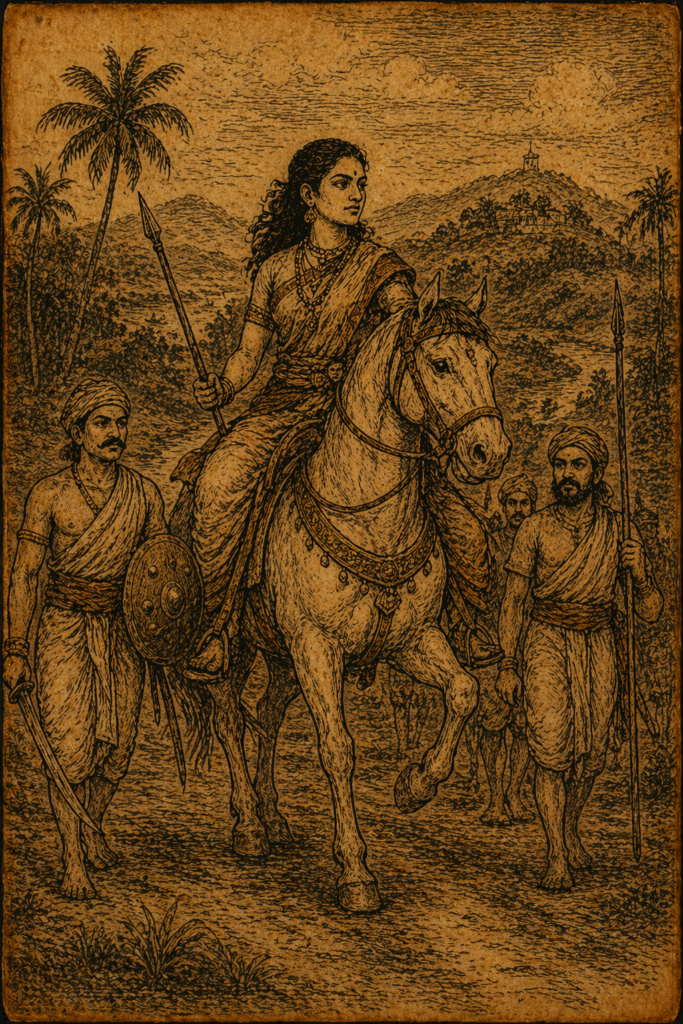
In Malabar, they said a woman’s place was in the home. Unniyarcha heard this and laughed.
The argument started the night before she left.
Kunhiraman was not a coward. This needs to be said clearly, because what followed could be misread as the protest of a weak man trying to control a strong woman, and it was not that. He was a Kalari master in his own right, trained in the same tradition that had produced the fighters of Puthooram Veedu, a man whose capability was not in question. His objection to his wife’s plan was not about her capability either. It was about the road.
Unniyarcha wanted to go to the temple festivals. Three of them — the Kuthu at Allimalarkavu, the Vilakku at Ayyappankavu, the Velapuram at Anjanakavu. She had made up her mind. This was not a new thing about her. When Unniyarcha made up her mind about something, the making up was thorough and final, in the way of someone who has thought through the objections already and found them insufficient.
The road passed through the bazaar at Nadapuram.
The Jonakas — the Mappila traders of the bazaar — were, in the language of the ballads, a dreaded lot on that stretch. Not all of them. But the headman’s men had a reputation for the kind of behavior toward women traveling alone that made the road something that respectable families thought carefully about. Kunhiraman had thought carefully about it. Her relatives had thought carefully about it. They told her what they thought.
She listened. Then she said she was going.
Kunhiraman understood, with the specific understanding of a man married to Unniyarcha, that there was no argument left to make. He picked up his weapons and went with her.
They set out in the morning, through the green of the Kadathanad countryside, through the coconut groves and the paths between the paddy fields, toward Nadapuram. The day was ordinary in the way that days are ordinary before they become stories. Birds. The smell of the earth. The sound of their footsteps.
Then the bazaar.
The Mappila headman saw her from across the market. The ballads record this moment with the economy of storytellers who know that some things need no elaboration: he saw her, and he wanted her, and he sent his men to take her.
This was his error. It was a large one.
The men came with the confidence of people accustomed to getting what their headman sent them to get. Unniyarcha watched them come. She had her urumi at her side — the flexible whip-sword, the weapon that requires years of serious training to use effectively because its blade moves in ways that a rigid weapon does not, because controlling it demands a quality of attention that most fighters never develop. She had been training with it since she was seven years old.
She drew it.
What followed in the bazaar at Nadapuram was not, by the standards of the Vadakkan Pattukal, a long fight. The ballads are specific: she injured many of the headman’s men. The rest fled. Kunhiraman, her husband — who had come to protect her and found that the protection was running in the other direction — was himself captured in the confusion and tied up.
Unniyarcha kept fighting.
When it was over, and the headman’s men had understood that the calculation they had made at the beginning of this encounter was wrong in ways they had not anticipated, the headman himself came to the scene. He arrived to find his men injured or fled, his attempt at abduction comprehensively defeated, and a woman standing in his bazaar with an urumi and no particular interest in having a conversation.
He recognized her then. She had announced herself during the fight — the sister of Aromal Chekavar, whose name the headman knew very well, because Aromal Chekavar was in fact the headman’s own fencing master. He had been training under the man whose sister he had just tried to have abducted.
He tried to apologize.
She was not interested in his apology.
He tried gifts. He sent emissaries. He asked influential people — the wife of the ruling chieftain, a Chetti who was a friend of the Chekavar family — to speak on his behalf, to soften her, to find some formula by which this could be resolved without further consequences.
None of them could move her.
The headman’s position was understood by everyone present: he had underestimated who she was, and the consequences of that underestimation were still unresolved, and Unniyarcha had no intention of resolving them on anyone’s terms but her own.
Then Aromal Chekavar arrived.
He had heard what had happened. He came not as an aggressor but as a brother — someone who understood both his sister and the situation, who could see that the headman had made a serious mistake and that the mistake required a serious response, and who also understood that what Unniyarcha wanted from this encounter was not blood but a promise.
The headman made the promise. In full, in front of witnesses, with the solemnity of a man who had spent the last several hours understanding exactly what it cost to underestimate the women of Puthooram Veedu. He swore that no woman traveling that road would be molested by his men again. He offered gifts. He tendered the kind of apology that the tradition recognized as genuine — not the apology of someone trying to make a problem go away, but the apology of someone who had grasped what they had done.
Only then did Unniyarcha sheath her urumi.
The road through Nadapuram bazaar was safer after that day. The ballads do not say for how long. They say that the promise was made, and that it was made because one woman on a festival morning refused to be told where she could and could not walk, and backed that refusal with a urumi and sixty-four ankams worth of training and the name of Puthooram Veedu and the complete absence of interest in what anyone thought about any of it.
Her husband was untied. They went to their festivals.
When they came home, the ballad singers were already composing the verses that would carry this day forward across the centuries — the day Unniyarcha walked into the Nadapuram bazaar and walked out on her own terms, which was the only kind of walking she had ever been interested in.
Unniyarcha is one of the legendary figures of Vadakkan Pattukal and appears in Aithihyamala, compiled by Kottarathil Sankunni in the early 20th century.